(13) Artificial Intelligence in Action: Elevating Precision and Early Detection in Post-Ablation Tumor Surveillance
Saturday, October 18, 2025
6:00 PM - 7:30 PM East Coast USA Time
Marcus Hong, BA – Medical Student, Ohio State University; Mina Makary, MD – Principle Investigator, Ohio State University
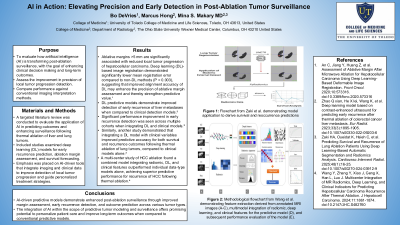
Purpose: To evaluate how artificial intelligence (AI) is transforming post-ablation surveillance by improving the precision of local tumor progression detection and outperforming conventional imaging interpretation methods, with the goal of enhancing clinical decision-making and long-term outcomes.
Material and Methods: A targeted literature review was conducted to evaluate the application of AI in predicting outcomes and enhancing surveillance following thermal ablation of liver and lung tumors. Included studies examined deep learning models for early recurrence prediction, ablation margin assessment, and survival forecasting. Emphasis was placed on AI-driven models that integrate imaging and clinical data to improve detection of local tumor progression and guide personalized treatment strategies.
Results: Ablative margins exceeding 5 mm are significantly associated with reduced local tumor progression in hepatocellular carcinoma (HCC). Deep learning (DL)-based image registration demonstrates superior alignment accuracy compared to traditional methods, enhancing the precision of margin assessment. DL models also improve early recurrence detection of liver metastases relative to clinical models, with consistently higher performance across cohorts. In lung tumors, combining DL with clinical variables improves prediction of both survival and recurrence. A multi-center study further demonstrated that integrating radiomic, DL, and clinical features improved recurrence prediction in HCC following ablation compared to models using individual data types alone.
Conclusions: AI-driven models enhance post-ablation surveillance by improving margin assessment, early recurrence detection, and outcome prediction across tumor types. By outperforming conventional models and enabling more precise follow-up, AI offers promising potential to personalize care and improve long-term outcomes.