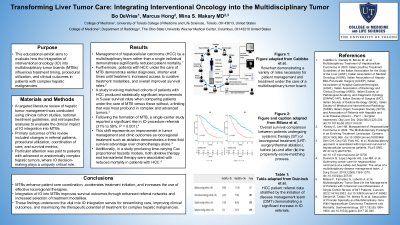
(14) Transforming Liver Tumor Care: Integrating Interventional Oncology into the Multidisciplinary Tumor Board
Saturday, October 18, 2025
6:00 PM - 7:30 PM East Coast USA Time
Marcus Hong, BA – Medical Student, Ohio State University; Mina Makary, MD – Principle Investigator, Ohio State University
Purpose: To evaluate how integration of interventional oncology (IO) into multidisciplinary tumor boards (MTBs) influences treatment timing, procedural utilization, and clinical outcomes in patients with complex hepatic malignancies.
Material and Methods: A targeted literature review was conducted using clinical cohort studies, national treatment guidelines, and retrospective analyses to evaluate the impact of IO integration into MTBs. Primary outcomes included changes in referral patterns, procedural utilization, coordination of care, and survival metrics. Particular attention was paid to patients with advanced or anatomically complex hepatic tumors, where IO decision-making plays a critical role.
Results: Patients with hepatocellular carcinoma managed through MTBs demonstrated decreased time to treatment and significantly reduced mortality, with matched cohorts showing improved 5-year survival—particularly in complex and advanced cases. After MTB implementation, a single-center study reported a significant increase in referrals for liver-directed therapies, including locoregional treatments such as ablation and transarterial approaches. Locoregional therapy showed a threefold survival advantage over chemotherapy alone. When controlling for patient, facility, and provider factors, ablative and transarterial therapies significantly improve overall survival compared to control interventions and Sorafenib.
Conclusions: Integrating IO into MTBs enhances multidisciplinary coordination, accelerates treatment initiation, and increases use of effective locoregional therapies, thereby improving survival in patients with complex hepatic malignancies. These findings underscore the MTB as a vital platform for streamlining care, improving clinical outcomes, and maximizing the therapeutic potential of interventional oncology.