(39) Locoregional Therapies Beyond the Liver: Emerging Applications in Extrahepatic Malignancies
Saturday, October 18, 2025
6:00 PM - 7:30 PM East Coast USA Time
Mina Makary, MD – Division of Interventional Radiology, Department of Radiology, The Ohio State University Wexner Medical Center
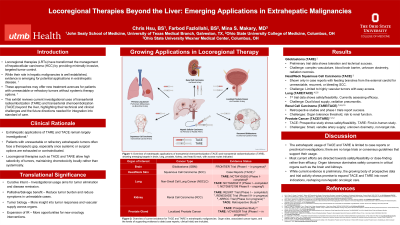
Purpose: Locoregional therapies have revolutionized the management of hepatocellular carcinoma (HCC), offering a minimally invasive alternative to surgical resection by delivering therapeutics directly to tumors. Although their efficacy in treating intrahepatic malignancies is well established within interventional oncology, emerging research suggests potential applications in extrahepatic disease. This educational exhibit aims to highlight the extrahepatic applications of transarterial radioembolization (TARE) and transarterial chemoembolization (TACE) and the challenges these techniques face that prevent widespread integration.
Material and Methods: A targeted literature search was performed using PubMed focusing on publications on extrahepatic applications of TARE and TACE. Clinical cases, small series, or emerging indications in malignancies such as renal cell carcinoma, soft tissue sarcoma, lung tumors, glioblastomas (GBM), and head and neck cancers were reviewed for current experiences, challenges and potential future directions.
Results: Extrahepatic use of TARE and TACE has shown success in select cancers as mentioned above. Reports describe technical feasibility, but published studies are primarily limited to case reports, retrospective case series, and canine models. Variability in tumor type, location, vascular anatomy, and embolization technique often necessitates individualized planning. This lack of standardization, combined with inconsistent dosimetry practices, makes it difficult to reproduce results and hinders clinical adoption. As a result, prospective clinical trials emerged such as the VOYAGER (NCT06192758) and FRONTIER (NCT05303467) trial to evaluate the safety and efficacy of Y-90 TARE in prostate cancer and GBM respectively. For TACE, a phase II trial (NCT05672108) is active for non-small cell lung cancer and metastases.
Conclusions: Although TACE and TARE show promising results, evidence remains limited, underscoring the need for investigation through research and multidisciplinary collaboration. Significant challenges persist to circumvent inconsistencies within the procedure and standardize embolization. Establishing evidence-based protocols and integrating prospective trial data will be crucial to guiding patient selection, safe implementation, and translating locoregional therapies into non-hepatic oncologic care.