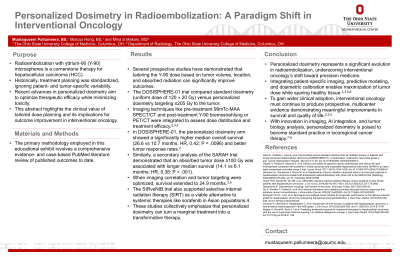
(56) Personalized Dosimetry in Radioembolization: A Paradigm Shift in Interventional Oncology
Saturday, October 18, 2025
6:00 PM - 7:30 PM East Coast USA Time
Marcus Hong, N/A – Medical Student, The Ohio State University College of Medicine; Mina Makary, MD – Physician, Radiology, The Ohio State University Wexner Medical Center
Purpose: Radioembolization with yttrium-90 (Y-90) microspheres is a cornerstone therapy for hepatocellular carcinoma (HCC). Historically, treatment planning was standardized, ignoring patient- and tumor-specific variability. Recent advances in personalized dosimetry aim to optimize therapeutic efficacy while minimizing toxicity. This abstract highlights the clinical value of tailored dose planning and its implications for outcome improvement in interventional oncology.
Material and Methods: A comprehensive literature review was conducted using peer-reviewed articles from PubMed.
Results: Prospective studies have demonstrated that tailoring the Y-90 dose based on tumor volume, location, and absorbed radiation can significantly improve outcomes. The DOSISPHERE-01 trial compared standard dosimetry (uniform dose of 120 ± 20 Gy) versus personalized dosimetry targeting ≥205 Gy to the tumor. Imaging techniques like pre-treatment 99mTc-MAA SPECT/CT and post-treatment Y-90 bremsstrahlung or PET/CT were integrated to assess dose distribution and treatment efficacy. In DOSISPHERE-01, the personalized dosimetry arm showed a significantly higher median overall survival (26.6 vs 10.7 months; HR, 0.42; P = .0096) and better tumor response rates. Similarly, a secondary analysis of the SARAH trial demonstrated that an absorbed tumor dose ≥100 Gy was associated with longer median survival (14.1 vs 6.1 months; HR, 0.38; P < .001). When imaging correlation and tumor targeting were optimized, survival extended to 24.9 months. The SIRveNIB trial also supported selective internal radiation therapy (SIRT) as a viable alternative to systemic therapies like sorafenib in Asian populations. These studies collectively emphasize that personalized dosimetry can turn a marginal treatment into a transformative therapy.
Conclusions: Personalized dosimetry represents a evolution in radioembolization, underscoring interventional oncology’s shift toward precision medicine. Integrating patient-specific imaging, predictive modeling, and dosimetric calibration enables maximization of tumor dose while sparing healthy tissue. To gain wider clinical adoption, interventional oncology must continue to produce prospective, multicenter evidence demonstrating improvements in survival and quality of life. With innovation in imaging, AI integration, and tumor biology analysis, personalized dosimetry is poised to become standard practice in locoregional cancer therapy.