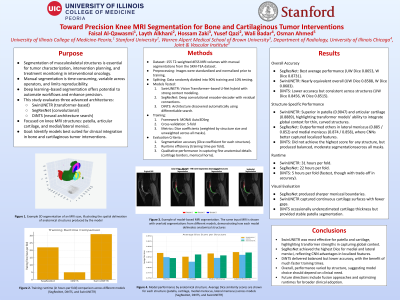
(4) Toward Precision Knee MRI Segmentation for Bone and Cartilaginous Tumor Interventions
Saturday, October 18, 2025
6:00 PM - 7:30 PM East Coast USA Time
Layth Alkhani, BS – Research Fellow, University of Chicago; Hossam Zaki, BS – Medical Student, Warren Alpert Medical School of Brown University; Yusef Qazi, BS, MS – ML Researcher, allGood; Wali Badar, MD – Integrated Diagnostic and Interventional Radiology Resident, Department of Radiology, University of Illinois Chicago / UI Health; Osman Ahmed, MD – Professor of Radiology, Department of Radiology, Section of Vascular & Interventional Radiology, University of Chicago
Purpose: As segmentation of anatomical structures becomes increasingly valuable in musculoskeletal interventional oncology, precise delineation of bone and cartilaginous structures can aid in tumor characterization, intervention planning, and treatment monitoring. This study evaluates the performance of three machine learning models—SwinUNETR, DiNTS, and SegResNet—for segmenting key knee structures (articular cartilage, lateral and medial menisci, and patella) from T2-weighted dESS MRI scans in the SKM-TEA dataset.
Material and Methods: A total of 155 T2-weighted MRIs with corresponding segmentations were used. The dataset was split into 90% training and 10% testing. Each model was trained using the MONAI Auto3DSeg framework with 5-fold cross-validation. Both weighted and unweighted Dice coefficients were reported for overall segmentation performance and each of the six segmented masks. The models were assessed based on segmentation accuracy, runtime efficiency, and their ability to capture fine anatomical details.
Results: SwinUNETR achieved the best performance in segmenting the patella (.90469) and articular cartilage (.88886), while SegResNet performed best in segmenting the lateral (.88462, .851789 ) and medial (.87362, .85765) menisci. DiNTS provided balanced results but did not outperform the other models for any specific structure. The average unweighted and weighted Dice scores for the overall segmentation were:
SegResNet: Average UW Dice: 0.8653, W Dice: 0.8731 DiNTS: Average UW Dice: 0.8456, W Dice: 0.8515 SwinUNETR: Average UW Dice: 0.8588, W Dice: 0.8683
SwinUNETR took 31 hours per fold to train, DiNTS took 5 hours, and SegResNet took 22 hours.
Conclusions: Transformer-based models like SwinUNETR are highly effective at segmenting specific knee structures, such as the patella and articular cartilage, while convolutional models like SegResNet excel at segmenting the menisci. Despite being outperformed in all segmentations, DiNTS still produced moderate results at a fraction of the training time. The runtime and performance differences suggest that model selection can be optimized or combined depending on clinical needs, such as precise tumor localization, intervention planning, or treatment response assessment in musculoskeletal interventional oncology. Future research should focus on improving segmentation times and creating fusion models.