(19) Radioembolization Tumor Lysis and Segmental Seeding: Unusual Progression After Segment 7 Radioembolization
Saturday, October 18, 2025
6:00 PM - 7:30 PM East Coast USA Time
Jeffrey Critchfield, M.D, FSIR – Interventional Radiology, Karmanos; Mithil Gudi, B.S – Medical Student, Wayne State University School of Medicine; Hussein Aoun, M.D – Interventional Radiology, Karmanos
Purpose: Yttrium-90 (Y-90) radioembolization is a well-established treatment for liver dominant metastases. While post-treatment progression is typically systemic or multi-segmental, we present a highly unusual case of clustered recurrence confined predominantly to the downstream treated angiosome following Y-90 therapy of a solitary lung cancer metastasis.
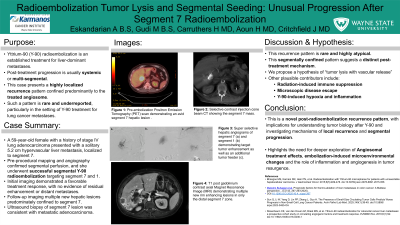
Material and Methods: A 59 year-old female with a history of stage IV lung adenocarcinoma presented with a solitary 5.2 cm hypervascular metastasis to hepatic segment 7. One month follow up imaging revealed 18 new metastatic foci, 16 confined to the segment 7 perfusion territory and two in adjacent segments (5 and 6). There was no evidence of systemic progression elsewhere.
Results: This recurrence pattern, predominantly confined to the treated angiosome, is rare and highly atypical. While recurrence in adjacent or untreated liver segments is well documented, this segmentally confined pattern showcases a unique post treatment outcome. One hypothesis we propose for this anomaly is “tumor lysis with vascular release”, in which embolization induced necrosis leads to intravascular tumor fragment dissemination within the segmental vascular bed. Similar mechanisms have been proposed in studies of small size circulating tumor cells in NSCLC. Alternatively, radiation induced immune suppression, or microscopic disease escape “showering” due to dose heterogeneity, could have had an important contribution. Lastly, Y-90 radioembolization induces localized tissue hypoxia and inflammation may contribute to angiogenic signaling within the treated segment, potentially contributing to localized segmental micrometastases through pro-growth environmental changes.
Conclusions: This rare post-radioembolization recurrence pattern adds to emerging evidence that post treatment progression can follow a segmental pattern. While similar patterns have been seen in NSCLC based studies, this is the first report to our knowledge that documents local clustering of recurrence confined to a single liver segment post Y-90. These findings may reflect an underrecognized association between radioembolization, tumor fragmentation, and localized vascular dynamics, meriting future investigation.