(31) Transformation of Patient Reported Outcome Measures for Assessing Value in Interventional Oncology
Saturday, October 18, 2025
6:00 PM - 7:30 PM East Coast USA Time
Priya Gupta, MD – Resident, Interventional Radiology, Henry Ford Health; Peter Massa, MD – Principal Investigator/Faculty, Interventional Radiology, Henry Ford Health
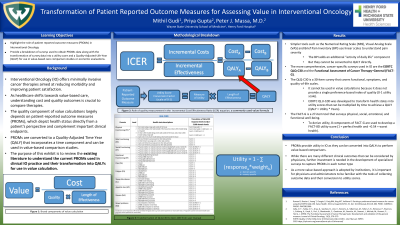
Purpose: Interventional Oncology (IO) offers minimally invasive cancer therapies aimed at reducing morbidity and improving patient satisfaction. As healthcare shifts towards value-based care, understanding cost and quality outcomes is crucial to compare therapies. The quality component of value calculations largely depends on patient-reported outcome measures (PROMs), which depict health status directly from a patient's perspective and complement important clinical endpoints. To enable standardized value comparisons, PROMs are converted to a Quality-Adjusted Time Year (QALY) that incorporates a time component. The purpose of this exhibit is to review the existing literature to understand the current PROMs used in clinical IO practice and their transformation into QALYs for use in value calculation.
Material and Methods: This exhibit presents a concise review of the PROMs utilized in the interventional treatment of various cancers and their transformation into a QALY.
Results: Several PROMs are used in clinical IO practice. Simple tools such as the Numerical Rating Scale (NRS), Visual Analog Scale (VAS) and Brief Pain Inventory (BPI) use linear scales to understand pain severity (the BPI adds an additional “activity of daily life” component), but they cannot be converted to QALY directly.
The more comprehensive, cancer-specific surveys used in IO are the EORTC QLQ-C30 and the Functional Assessment of Cancer Therapy–General (FACT-G).
The QLQ-C30 is a 30-item survey that covers functional, symptoms, and quality-of-life scales. While it is widely used in cancer clinical trials, it cannot be used in value calculations because it does not provide a single preference-based index of quality. To combat this, the EORTC QLU-10D was developed to transform health states into utility scores that can be multiplied by time to achieve a QALY (QALY = Utility * Years).
The FACT-G is a 27-item tool that surveys physical, social, emotional, and functional well-being. To derive utility, 8 components of FACT-G are used to develop a FACT-8D utility score (1 = perfect health and –0.54 = worst health).
Conclusions: PROMs provide utility in IO as they can be converted into QALYs to perform value-based comparisons. As a more value-based approach is adopted by institutions, it is important for physicians and administrators to be familiar with the tools of collecting outcome data and their conversion to utility scores.