(12) Minimal Attire Requirement for Procedures in Interventional Radiology, in the Absence of Semi Restricted Hallway.
Saturday, October 18, 2025
6:00 PM - 7:30 PM East Coast USA Time
Tania Bubb, PhD, RN, FAPIC – Senior Director of Infection Control, Memorial Sloan Kettering Cancer Center; Michell Reyes, RN, CIC – Manager, Infection Control, Nuvance Health
Purpose: Interventional radiology staff lacked guidance on what type of attire to wear in the Procedure Suite while Procedures are happening. Infection Control conducted observations on a fast-paced Interventional Radiology Clinic, located in an urban tertiary cancer center, identified that risk of getting infection under an uncontrolled environment was analyzed to come up with guidance.
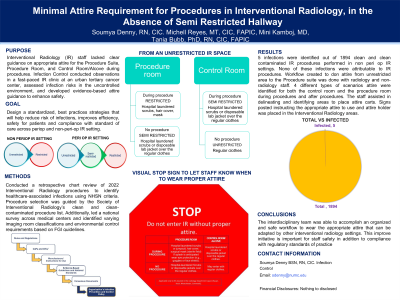
Material and Methods: The Interventional radiology procedure suite was classified in two areas; the control room and the procedure room, reviewed literature and standards of practices recommended by different recognized National Associations, Joint Commission’s infection control hierarchical approach was used, retrospective patient’s chart reviewed to identify healthcare- acquired infections, related to Interventional Radiology procedures using the National Safety Health Network criteria. Conducted National Survey with other Medical Centers. Identified different types of imaging class and their environmental control requirements.
Results: 5 infections were identified out of 1894 patient’s chart reviews. Types of procedure performed included clean, clean contaminated, contaminated, dirty. Workflow created to don attire from unrestricted area to the Procedure suite was done with radiology and non-radiology staff. 4 different types of scenarios attire were identified for both the control room and the procedure room during procedures and after procedures. The staff assisted in delineating and identifying areas to place attire carts. Signs posted instructing the appropriate attire to use and attire holder was placed in the Interventional Radiology areas.
Conclusions: The interdisciplinary team was able to accomplish an organized and safe workflow to wear the appropriate attire that can be adapted by other interventional radiology settings. This improve initiative is important for staff safety in addition to compliance with regulatory standards of practice.