(54) A Case of Delayed Diagnosis of Gastric Ulcerations Due to Non-target Yttrium 90 Radioembolization
Saturday, October 18, 2025
6:00 PM - 7:30 PM East Coast USA Time
Conor Honan, MD – Resident Physician, University of Colorado; David Owens, DO – Doctor, Assistant Professor, Vascular and Interventional Radiology, Saint Louis University Hospital
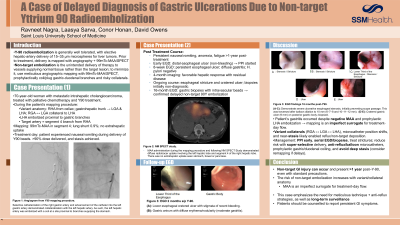
Purpose: Non-target embolization of Yttrium 90 (90Y) is a rare but well known complication of 90Y-radioembolization during treatment of hepatocellular carcinoma. Despite familiarity with this complication, diagnosis can be challenging due to the nonspecific symptoms that develop. We present a case of delayed diagnosis and development of gastritis one year after 90Y radioembolization.
Material and Methods: A retrospective chart review was conducted with review of the procedural notes, pre-procedural planning, subsequent clinical course, imaging, esophagogastroduodenoscopy (EGDs), and biopsies.
Results: A 70-year-old female with metastatic intrahepatic cholangiocarcinoma underwent 90Y radioembolization, which was complicated by persistent nausea and anorexia for over a year. Her pretreatment angiogram revealed variant anatomy, including a replaced left hepatic artery, which was embolized proximal to gastric branches to minimize the risk of non-target embolization. Pretreatment mapping showed no extrahepatic uptake. However, during the actual treatment, she developed nausea and vomiting, leading to cessation of the procedure. At that point, over 90% of the dose had already been delivered. Following radioembolization, she continued to experience persistent upper gastrointestinal (GI) symptoms. An initial EGD revealed a non-bleeding distal esophageal ulcer with biopsy findings of granulation tissue and atypical glands. She was started on a proton pump inhibitor with partial relief, but her symptoms persisted. Over the course of a year, she underwent several additional EGDs and biopsies, all of which were nondiagnostic. Finally, 16 months after treatment, biopsies revealed oxyntic mucosa with chronic gastritis and intravascular 90Y beads, confirming the diagnosis of non-target embolization and explaining her prolonged symptoms.
Conclusions: This case demonstrates the importance of remaining vigilant of the rare side effects associated with 90Y treatment, even in the face of negative workup and biopsies. Although this patient underwent multiple EGDs that did not reveal any 90Y particles, it is essential to note that biopsies may not always be sensitive enough to detect them. In patients without significant risk factors for chronic gastritis, or whose symptom onset aligns with treatment, keeping GI ulcers and gastritis from radioembolization high on the differential can help avoid delays in diagnosis.