(36) AI-Enhanced Prediction of TACE Outcomes in Hepatocellular Carcinoma: Unlocking Clinical Insight and Precision
Saturday, October 18, 2025
6:00 PM - 7:30 PM East Coast USA Time
Bo DeVries, B.S. – Medical Student, The University of Toledo College of Medicine; Mustaqueem Pallumeera, B.S. – Medical Student, The Ohio State University College of Medicine; Mina Makary, M.D. – Associate Clinical Professor of Radiology, Department of Radiology, The Ohio State University College of Medicine
Purpose: To synthesize published data on the development and performance of artificial intelligence (AI) and machine learning (ML) models designed to predict therapeutic response to transarterial chemoembolization (TACE) in patients with hepatocellular carcinoma (HCC).
Material and Methods: A comprehensive review of current literature was performed, focusing on the use of AI and ML for predicting outcomes following TACE in patients with HCC. Sources included clinical trials, retrospective studies, and validation cohorts involving AI-driven models.
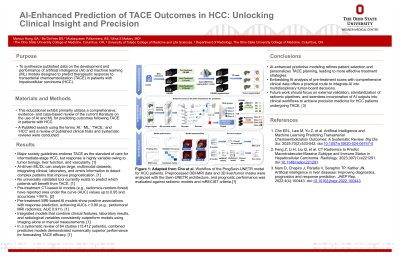
Results: TACE is a mainstay treatment for intermediate-stage HCC, but outcomes vary widely depending on tumor biology, liver function, and vascularity. AI, particularly ML and deep learning (DL), enables advanced analysis of large datasets for HCC diagnosis by recognizing complex patterns and integrating clinical and omics data to improve outcome prediction accuracy. Currently, no standardized tools reliably predict which patients will benefit from TACE. Trials applying AI to pre-TACE CT and MRI scans have been found to significantly enhance predictive accuracy. Specifically, models that combined clinical features, laboratory results, and radiological data outperformed those relying solely on imaging or manual measurements. The findings suggest that integrated predictive models can effectively forecast TACE responses, highlighting the potential of AI in improving treatment outcomes for intermediate-stage HCC patients.
Conclusions: AI-enhanced predictive modeling optimizes TACE outcomes for HCC patients by integrating diverse data and improving decision-making. AI's ability to analyze pre-treatment scans and combine clinical data enhances patient selection and treatment planning, leading to more effective strategies. Future efforts should focus on refining AI models and integrating them into clinical workflows to enable personalized decisions and improve outcomes for HCC patients undergoing TACE.