(7) Yttrium-90 (Y-90) Radioembolization in a Freestanding, Office-Based Lab
Saturday, October 18, 2025
6:00 PM - 7:30 PM East Coast USA Time
Micheal Shirazi, MD – Interventional Radiology, Interventional Radiology, Summit Health; Joseph DeMarco, DO – Interventional Radiologist, Interventional Radiology, Summit Health; Waseem Bhatti, MD, MS – Medical Director, Interventional Radiology, Summit Health
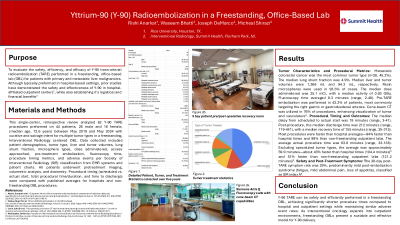
Purpose: To evaluate the safety, efficiency, and efficacy of Y-90 Radioembolization in a Freestanding, Office-Based Lab.
Material and Methods: This single-center retrospective study reviewed 62 Y-90 transarterial radioembolization (TARE) procedures on 44 patients with primary or metastatic liver neoplasms over a 60mo period. Data collected included fluoroscopy time, lung shunt, dose administered, tumor and liver volumes, adverse events, and procedure logistics. All patients underwent pretreatment imaging and dosimetry using triple-phase CT and software-based volumetric analysis. Pre-treatment and post-treatment assessments followed SIR classification standards. Time metrics, including delay between scheduled and actual procedure time, as well as time to discharge, were compared to published averages from affiliated OBLs and hospital-based procedures.
Results: All patients underwent Y-90 TARE without major complications. Most common tumor type was metastatic colorectal cancer (n=28, 45.2%). Median lung shunt was 4.9% (range, 2.4%-18.8%). Median liver volume was calculated to be 1,368 mL (range, 204-3557 mL), while median tumor volume was calculated to be 94.25 mL (range, 5-1172 mL). The median dose administered was 25.08 mCi (range, 7.45-10 mCi), and median activity was 0.93 GBq (range, 0.28-3.89 GBq). The median fluoroscopy time was calculated to be 8.3 mins (range, 2-48 mins). 19 patients (43%) underwent embolization pre-TARE. The most common vessels embolized were the right gastric artery and the gastroduodenal artery. The median between scheduled procedure time and actual procedure time was 19 mins (range, 3-41 mins). The median time between actual procedure time and discharge, which includes time it takes to undergo procedure post-operational recovery, was 212 mins (range, 119-443 mins). 94% (58) of procedures were faster than the average hospital procedure time, and 89% (55) of procedures were faster than the average non-freestanding OBL procedure time.
Conclusions: TARE with Y-90 in a freestanding OBL setting is both feasible and safe with primary and metastatic disease. Procedures performed in the freestanding OBL setting were significantly faster and less delayed comparatively than of a non-freestanding and hospital setting with consistent outcomes and low complication rates. As the future of Interventional Radiology care shifts to the outpatient setting, freestanding OBLS represent a viable and scalable model for Y-90 delivery.