(67) Clinical Applications of Liquid Biopsies in Endometrial Cancer: A Comprehensive Review
Saturday, October 18, 2025
6:00 PM - 7:30 PM East Coast USA Time
Luis Lorenzo Carvajal, BS – Medical Student, HWCOM; Andres Wong, BS – Medical Student, HWCOM
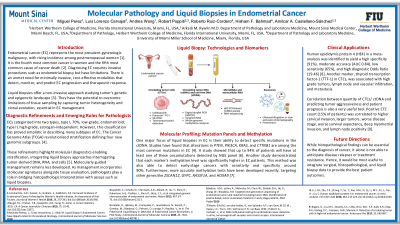
Purpose: Endometrial cancer (EC) is the most prevalent gynecologic malignancy in developed countries including the United States. It has been traditionally diagnosed through invasive procedures such as hysteroscopy and tissue biopsies. This approach may not capture tumor heterogeneity or allow for real-time disease tracking. Therefore, with the constant advancement of liquid biopsies, there is a potential for less invasive ways to diagnose EC.
Material and Methods: Currently, the World Health Organization (WHO) classifies EC based on histomorphology into various subtypes. However, this classification may evolve in the future, as liquid biopsies enabling the detection of specific genetic signatures have the potential to facilitate molecular-based classification of EC, similar to the approach used for central nervous system tumors. Furthermore, liquid biopsies are not only promising as a diagnostic tool, but they could also be used as a way to monitor outcomes after surgery and residual disease, which cannot be done using standard methods.
Results: The most analyzed and studied biomarkers that allow this to happen are circulating tumor cells (CTCs), circulating tumor DNA (ctDNA), cell-free DNA (cfDNA), microRNA, and exosomes. Even though the method of blood collection is the same for all samples, there are different methods to analyze these biomarkers, such as the Parsortix system for circulating tumor cells.
Conclusions: These promising innovations should be carefully analyzed since they are likely to improve health outcomes if integrated into the current practices for EC diagnosis, therapy, and monitoring for oncological patient care.