(43) Locoregional Therapy in Ovarian Cancer Metastasis: An Area Necessitating Further Investigation
Saturday, October 18, 2025
6:00 PM - 7:30 PM East Coast USA Time
Lauren Stucky, BS – Medical Student, The Ohio State University College of Medicine; Elliott Fite, MS – Medical Student, The Ohio State University College of Medicine; Mina Makary, MD – Associate Clinical Professor of Radiology, Department of Radiology, The Ohio State University Medical Center
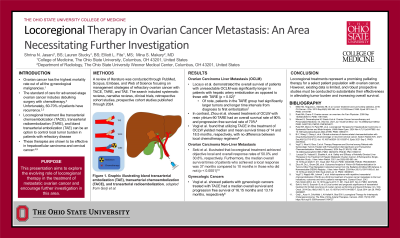
Purpose: Ovarian cancer has the highest mortality rate out of all the gynecological malignancies. The standard of care for advanced-stage ovarian cancer includes debulking surgery with chemotherapy. Unfortunately, 60-70% of patients experience recurrence. For patients with metastatic ovarian cancer refractory or intolerant to chemo- or radio-therapy, locoregional treatment like transarterial chemoembolization (TACE), transarterial radioembolization (TARE), and bland transarterial embolization (TAE) can be an option to control local tumor burden. These therapies are shown to be effective in hepatocellular carcinoma and cervical cancer. The purpose of this abstract is to explore the evolving role of locoregional therapy in the treatment of metastatic ovarian cancer.
Material and Methods: A review of literature was conducted through PubMed, Scopus, Embase, and Web of Science. The search included systematic reviews, narrative reviews, clinical trials, retrospective cohort studies, prospective cohort studies published through 2024.
Results: Patients with gynecologic cancers treated with TACE had a median overall survival and progression free survival of 16.15 months and 13.19 months, respectively. In patients with unresectable ovarian carcinoma liver metastasis (OCLW), the overall survival was significantly longer in patients with hepatic artery embolization as opposed to those with TARE (p = 0.02). However, patients in the TARE group had significantly larger tumors and longer time intervals from diagnosis to first embolization. In a study analyzing outcomes of resin yttrium-90 TARE on liver metastases, treatment of OCLW showed an overall survival rate of 90% and progression free survival rate of 70%. Another study investigating TACE in the treatment of OCLW yielded median and mean survival times of 14 and 18.5 months, respectively, with no difference between local chemotherapy regimens. In non-liver metastasis, a study showed that locoregional treatment achieved objective local and overall response rates of 50.0% and 30.8%, respectively. Furthermore, the median overall survival times of patients who achieved a local response was 37 months compared to 10 months in those who did not (p < 0.0001).
Conclusions: Locoregional treatments represent a promising palliating therapy for a select patient population with ovarian cancer. However, robust prospective studies must be conducted to substantiate their effectiveness.