(86) Intra-Arterial Nanoparticle Therapy for Pancreatic Adenocarcinoma: Emerging Evidence and Therapeutic Potential
Saturday, October 18, 2025
6:00 PM - 7:30 PM East Coast USA Time
Mina Makary, MD – Associate Professor, Division of Interventional Radiology, The Ohio State University Wexner Medical Center
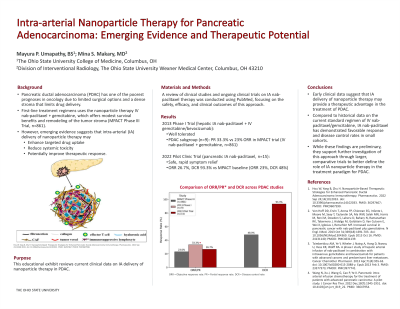
Purpose: Pancreatic ductal adenocarcinoma (PDAC) has one of the poorest prognoses in oncology, largely due to limited indications of surgical resection and a dense stroma that limits drug delivery. First-line treatment regimens involve intravenous (IV) administration of nanoparticle agents like nab-paclitaxel combined with gemcitabine, which offers modest survival benefits and remodeling of the tumor stroma. However, emerging evidence suggests that intra-arterial (IA) delivery of nanoparticle therapy may enhance targeted drug uptake, reduce systemic toxicity, and improve therapeutic response. This educational exhibit reviews current clinical data on IA delivery of nanoparticle therapy in PDAC.
Material and Methods: A review of clinical studies and ongoing clinical trials on IA nab-paclitaxel therapy was conducted using PubMed, focusing on the safety, efficacy, and clinical outcomes of this approach.
Results: A 2013 phase I trial evaluating hepatic artery infusion of nab-paclitaxel combined with intravenous (IV) gemcitabine and bevacizumab in patients with advanced cancers and predominant liver metastases found this approach to be well tolerated and potentially effective. Among PDAC patients (n=9) in this study, the partial response (PR) rate was 33.3%, compared to a 23% overall response rate (ORR) with IV gemcitabine/nab-paclitaxel reported in the MPACT phase III trial (n=861), which established this regimen as a standard first-line therapy for metastatic PDAC. In a separate 2022 study, pancreatic artery infusion of nab-paclitaxel in patients with advanced PDAC (n=15) was safe and associated with rapid symptom relief. The observed ORR and disease control rate (DCR) were 26.7% and 93.3%, respectively, exceeding MPACT trial baseline data (ORR: 23%; DCR: 48%).
Conclusions: Early clinical data suggest that IA delivery of nanoparticle therapy may provide a therapeutic advantage in the treatment of PDAC. Compared to historical data on the current standard regimen of IV nab-paclitaxel/gemcitabine, IA nab-paclitaxel has demonstrated favorable response and disease control rates in small cohorts. While these findings are preliminary, they support further investigation of this approach through larger, comparative trials to better define the role of IA nanoparticle therapy in the treatment paradigm for PDAC.