(71) Immuno-oncology: A primer for the Interventional Radiologist
Saturday, October 18, 2025
6:00 PM - 7:30 PM East Coast USA Time
Elliott Fite, MS – Medical Student, The Ohio State University College of Medicine; Nikhil Sekar, BA – Medical Student, The Ohio State University College of Medicine; Jenish Venancius, MPH – Medical Student, The Ohio State University College of Medicine; Mina Makary, MD – Associate Clinical Professor of Radiology, Department of Radiology, The Ohio State University Medical Center
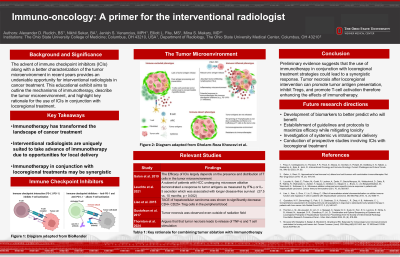
Purpose: The advent of immune checkpoint inhibitors (ICIs) along with a better characterization of the tumor microenvironment in recent years provides an undeniable opportunity for interventional radiologists in cancer treatment. This abstract outlines the mechanisms of immunotherapy, describes the tumor microenvironment, and highlights promising opportunities for interventional radiologist to incorporate immunotherapy into treatment strategies based on contemporary literature during the past decade from 2015 to 2025.
Material and Methods: A review of the literature was conducted, evaluating PubMed-indexed studies on the use of immunotherapy in conjugation with interventional radiology procedures between 2015 and 2025. The search included systematic reviews, narrative reviews, clinical trials, guidelines, and retrospective cohort studies.
Results: As systemic immunotherapy transforms the cancer treatment landscape, interventional radiologists are uniquely suited to take advantage of these new treatment modalities. While immunotherapy in combination with chemotherapy has benefited many patients, its conjunction with locoregional treatments may offer additional benefit [1]. Recent advances in the characterization of the tumor microenvironment have shown that response to ICIs largely depends on the presence and distribution of T cells in the tumor microenvironment [2]. Therefore, there is clear rationale for synergy with locoregional treatments as multiple studies have demonstrated increased anti-tumor immune response following intervention. For instance, a subset of patients with HCC undergoing microwave ablation demonstrated a response to tumor antigens as measured by IFN-γ or IL-5 secretion which was associated with longer disease-free survival (27.5 vs. 10 months; p = 0.002) [3]. Additionally, TACE of hepatocellular carcinoma was shown to significantly decrease CD4+ CD25+ Treg cells in the peripheral blood [4]. Furthermore, it has been hypothesized that since tumor regression has been observed even outside of radiation treatment fields, that tumor necrosis leads to release of TNF-α and T cell stimulation [5, 6]. This provides further rationale that local ablation could augment systemic ICI therapy.
Conclusions: Preliminary evidence suggests that the use of immunotherapy in conjunction with locoregional treatment strategies could lead to a synergistic response, warranting further investigation.