(53) High-Intensity Focused Ultrasound: Applications in Immunomodulation for Oncological Treatment
Saturday, October 18, 2025
6:00 PM - 7:30 PM East Coast USA Time
Ankit Patel, BS – Medical Student, Northeast Ohio Medical University; Mina Makary, MD – Interventional Radiologist, Vascular and Interventional Radiology, The Ohio State University Wexner Medical Center
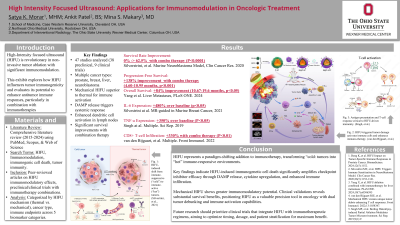
Purpose: High-intensity focused ultrasound (HIFU) has emerged as a non-invasive therapeutic modality with promising immunomodulatory effects in oncology. This exhibit explores how HIFU influences tumor immunogenicity and evaluates its potential to enhance antitumor immune responses, particularly in combination with immunotherapies.
Material and Methods: A comprehensive literature review (2015-2024) was conducted, focusing on preclinical and clinical studies evaluating HIFU-induced immunomodulation. Key sources included recent findings on HIFU’s ability to induce immunogenic cell death, release tumor-associated antigens, and modulate the tumor microenvironment. Experimental models assessed cytokine profiles, dendritic cell activation, and T-cell infiltration post-HIFU treatment. Comparative analyses were performed between HIFU monotherapy and combination approaches involving checkpoint inhibitors and adoptive cell therapies.
Results: HIFU’s mechanical and thermal properties contribute to localized tumor ablation while concurrently triggering systemic immune responses. Studies demonstrate increased expression of damage-associated molecular patterns (DAMPs), enhanced antigen presentation, and recruitment of cytotoxic T lymphocytes. Notably, HIFU-treated tumors exhibit upregulation of pro-inflammatory cytokines such as IL-6 and TNF-α, fostering an immunostimulatory environment. When paired with immune checkpoint blockade, HIFU amplifies therapeutic efficacy by overcoming tumor-induced immunosuppression. However, variation in treatment parameters and immune outcomes highlights the need for future research on standardized protocols and biomarker-driven patient selection.
Conclusions: HIFU represents a compelling adjunct to immunotherapy, capable of transforming immunologically “cold” tumors into “hot” ones. Its dual role in tumor debulking and immune activation positions it as a versatile tool in oncological treatment. Future research should prioritize clinical trials that integrate HIFU with immunotherapeutic regimens, aiming to optimize timing, dosage, and patient stratification for maximum benefit.