(84) Freezing the Pain: Clinical Applications of Cryoablation in Metastatic Bone Disease
Saturday, October 18, 2025
6:00 PM - 7:30 PM East Coast USA Time
Elliott Fite, MS – Medical Student, The Ohio State University College of Medicine; Mina Makary, MD – Associate Clinical Professor of Radiology, Department of Radiology, The Ohio State University Medical Center
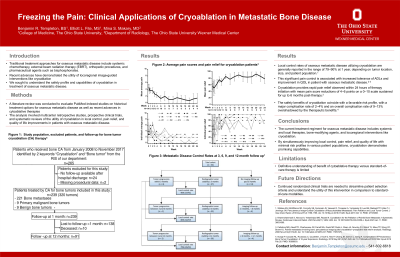
Purpose: Traditional treatment approaches for osseous metastatic disease include systemic chemotherapy, external beam radiation therapy (EBRT), orthopedic procedures, and pharmaceutical agents such as biphosphonates. Recent advances have demonstrated the utility of locoregional image-guided interventions like cryoablation. This abstract explores the safety profile and capabilities of cryoablation in treatment of osseous metastatic disease.
Material and Methods: A literature review was conducted to evaluate PubMed-indexed studies on historical treatment options for osseous metastatic disease as well as recent advances in cryoablative therapies. The analysis involved multicenter retrospective studies, prospective clinical trials, and systematic reviews of the utility of cryoablation in local control, pain relief, and quality of life improvements in patients with osseous metastatic disease.
Results: Local control rates of osseous metastatic disease using cryoablation are generally reported in the range of 79–90% at 1 year, depending on tumor location, size, and patient population. Additionally, cryoablation provides rapid pain relief observed within 24 hours of therapy initiation with mean pain score reductions of 4–6 points on a 0–10 scale sustained for up to 6 months post-therapy. This significant pain control is associated with increased tolerance of ADLs and improvement in QOL in patient with osseous metastatic disease. These benefits coincide with a favorable risk profile, with a major complication rate of 2–4% and an overall complication rate of 9–13% overshadowed by the therapeutic benefits.
Conclusions: The current treatment regiment for osseous metastatic disease includes systemic and local therapies, bone-modifying agents, and locoregional interventions like cryoablation. By simultaneously improving local control, pain relief, and quality of life with minimal risk profiles in various patient populations, cryoablation demonstrates promising capabilities. Continued randomized clinical trials are needed to streamline patient selection criteria and understand the utility of this intervention in comparison to standard-of-care modalities.