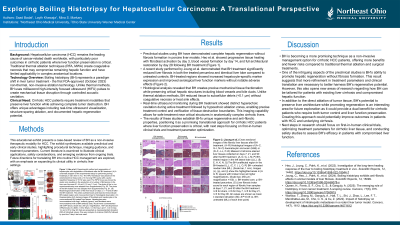
(9) Exploring Boiling Histotripsy for Hepatocellular Carcinoma: A Translational Perspective
Saturday, October 18, 2025
6:00 PM - 7:30 PM East Coast USA Time
Layth Khawaja, BS – Medical Student, Northeast Ohio Medical University; Mina Makary, MD – Clinical Assistant Professor, Division of Vascular and Interventional Radiology, The Ohio State University Wexner Medical Center
Purpose: Boiling histotripsy (BH) is an emerging non-invasive, ultrasound-based technique that ablates liver tumors through mechanical tissue disruption without thermal injury. Beyond tumor destruction, BH has demonstrated potential in promoting hepatic regeneration. This abstract explores the translational relevance of BH in the treatment of hepatocellular carcinoma (HCC) within cirrhotic livers, emphasizing its role as a novel therapeutic strategy.
Material and Methods: This educational exhibit presents a case-based review of BH as a non-invasive therapeutic modality for HCC. The exhibit synthesizes available preclinical and early clinical studies, highlighting procedural technique, imaging guidance, and treatment parameters. Current literature is examined to illustrate clinical applications, safety considerations, and emerging evidence from ongoing trials. Future directions for translating BH into routine HCC management are explored, with an emphasis on expanding its clinical utility in cirrhotic liver settings.
Results: This educational exhibit will (1) introduce the core principles of BH, including its use of high-intensity focused ultrasound to induce mechanical tissue fractionation without thermal injury; (2) review preclinical studies demonstrating increased hepatocyte regeneration and preserved liver function following BH in animal models; and (3) highlight translational applications for HCC, including case reports showing complete tumor necrosis and its emerging use as a bridging therapy to liver transplantation. The exhibit will also explore procedural advantages such as real-time ultrasound visualization of cavitation, sharply defined ablation margins, and safety in anatomically complex or thermally sensitive hepatic environments. These findings support BH’s potential as a novel, non-invasive treatment option for patients with HCC and underlying cirrhosis.
Conclusions: After reviewing this exhibit, the viewer will understand the mechanisms, current evidence, and translational potential of BH for the treatment of HCC in cirrhotic patients. The exhibit also highlights BH’s potential advantages over traditional thermal ablation techniques, particularly in cirrhotic liver contexts, and emphasizes the need for continued clinical research to establish its role as a standard therapeutic option.