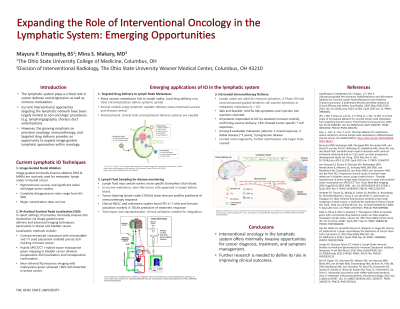
(87) Expanding the Role of Interventional Oncology in the Lymphatic System: Emerging Opportunities
Saturday, October 18, 2025
6:00 PM - 7:30 PM East Coast USA Time
Mina Makary, MD – Associate Professor, Division of Interventional Radiology, The Ohio State University Wexner Medical Center
Purpose: The lymphatic system plays a critical role in cancer defense and progression by facilitating metastatic spread and modulating the antitumor immune response, with roles in both immune surveillance and evasion. Despite its significance, interventional approaches targeting the lymphatic network have been largely limited to non-oncologic procedures, such as lymphangiography and thoracic duct embolization for chyle leaks and lymphatic malformations. However, the growing emphasis on precision oncology, immunotherapy, and targeted drug delivery provides an opportunity to expand image-guide lymphatic approaches within oncology. Emerging applications include lymphatic-directed therapies, image-guided nodal interventions, and lymphatic access to support molecular profiling.
Material and Methods: This educational exhibit reviews current preclinical and clinical evidence on interventional oncology procedures involving the lymphatic system. Key findings are highlighted regarding the safety, feasibility, and efficacy of novel interventional strategies involving lymphatic access, image-guided lymph node procedures, and their potential role in precision oncology.
Results: This educational exhibit will: (1) review the current role of IR in lymphatic imaging and interventions, (2) explore emerging applications of lymphatic-directed techniques in oncology, including targeted drug delivery, image-guided nodal biopsy and ablation, IR-assisted sentinel node localization, and lymphatic access to support precision oncology in diagnosis and disease monitoring, (3) discuss gaps limiting the use of these procedures in current practice, and (4) propose areas for future research and expansion.
Conclusions: Interventional oncology has a promising role in the lymphatic system, introducing novel, effective, and minimally invasive opportunities for cancer diagnosis, treatment, and symptom management. Further research and advancement are needed to determine the role of lymphatic interventions in improving clinical outcomes.