(18) Emerging Role of Transarterial Chemoembolization in Lung Cancer: Feasibility, Integration, and Future Directions
Saturday, October 18, 2025
6:00 PM - 7:30 PM East Coast USA Time
Israel Ailemen, BS – Medical Student, The Ohio State University College of Medicine; Elliott Fite, MS – Medical Student, The Ohio State University College of Medicine; Mina Makary, MD – Associate Clinical Professor of Radiology, Department of Radiology, The Ohio State University Medical Center
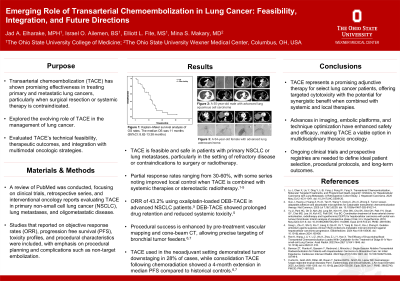
Purpose: Transarterial chemoembolization (TACE) has shown promising effectiveness in treating primary and metastatic lung cancers, particularly when surgical resection or systemic therapy is contraindicated. This abstract explores the evolving role of TACE in the management of lung cancer, with an emphasis on its technical feasibility, therapeutic outcomes, and integration with multimodal oncologic strategies.
Material and Methods: A review of PubMed was conducted, focusing on clinical trials, retrospective series, and interventional oncology reports evaluating TACE in primary NSCLC, lung metastases, and oligometastatic disease. Studies that reported on objective response rates (ORR), progression free survival (PFS), toxicity profiles, and procedural characteristics were included, with emphasis on procedural planning and complications such as non-target embolization.
Results: Emerging evidence suggests that TACE is feasible and safe in patients with primary NSCLC or lung metastases, particularly in the setting of refractory disease or contraindications to surgery or radiotherapy. Retrospective studies report partial response rates ranging from 30-60%, with some series noting improved local control when TACE is combined with systemic therapies or stereotactic radiotherapy. One study reported an ORR of 43.2% using oxaliplatin-loaded DEB-TACE in advanced non-small cell lung cancer patients. DEB-TACE has shown favorable pharmacokinetic profiles, with prolonged drug retention and reduced systemic toxicity. Procedural success is enhanced by pre-treatment vascular mapping and cone-beam CT, allowing precise targeting of bronchial tumor feeders. In early-phase trials, TACE used in the neoadjuvant setting demonstrated tumor downstaging in 28% of cases, while consolidation TACE following chemoradiation showed a 4-month extension in median PFS compared to historical controls.
Conclusions: TACE represents a promising adjunctive therapy for select lung cancer patients, offering targeted cytotoxicity with the potential for synergistic benefit when combined with systemic and local therapies. Advances in imaging, embolic platforms, and technique optimization have enhanced safety and efficacy, making TACE a viable option in multidisciplinary thoracic oncology. Ongoing clinical trials and prospective registries are needed to define ideal patient selection, procedural protocols, and long-term outcomes.