(83) Contraindications and Safety Pitfalls in TARE: How to Optimize Outcomes in Complex Liver Anatomy
Saturday, October 18, 2025
6:00 PM - 7:30 PM East Coast USA Time
Elliott Fite, MS – Medical Student, The Ohio State University College of Medicine; Mina Makary, MD – Associate Clinical Professor of Radiology, Department of Radiology, The Ohio State University Medical Center
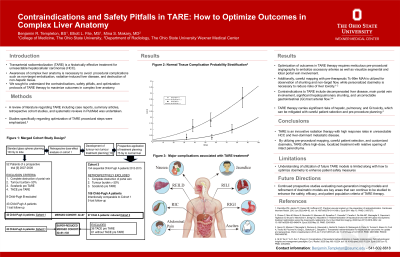
Purpose: Transarterial radioembolization (TARE) is an effective treatment for unresectable hepatocellular carcinomas (HCC). Awareness of complex liver anatomy is necessary to avoid procedural complications such as non-target embolization, radiation-induced liver disease, and destruction of non-hepatic tissue. This abstract discusses the contraindications, safety pitfalls, and optimization protocols of TARE therapy to maximize outcomes in complex liver anatomy.
Material and Methods: A review of literature regarding TARE including case reports, summary articles, retrospective cohort studies, and systematic reviews in PubMed was undertaken. Studies specifically regarding optimization of TARE procedural steps were emphasized.
Results: Optimization of outcomes in TARE therapy requires meticulous pre-procedural angiography to embolize accessory arteries as well as visualize segmental and lobar portal vein involvement. Additionally, careful mapping with pre-therapeutic Tc-99m MAA is utilized for observation of shunting and non-target flow, while personalized dosimetry is necessary to reduce risks of liver toxicity. Contraindications to TARE include decompensated liver disease, main portal vein involvement, significant hepatopulmonary shunting, and uncorrectable gastrointestinal (GI) tract arterial flow.3 TARE therapy carries significant risks of hepatic, pulmonary, and GI toxicity, which can be mitigated with careful patient selection and pre-procedure planning.
Conclusions: TARE is an innovative radiation therapy with high response rates in unresectable HCC and liver-dominant metastatic disease. By utilizing pre-procedural mapping, careful patient selection, and customized dosimetry, TARE offers high-dose, localized treatment with relative sparing of intact parenchyma. Continued prospective studies evaluating next-generation imaging models and refinement of dosimetric models are key areas that can continue to be studied to enhance the safety, efficacy, and patient population criteria of TARE therapy.