(1) Chemoembolization for Renal Cell Carcinoma: Revisiting an Underexplored Locoregional Therapy
Saturday, October 18, 2025
6:00 PM - 7:30 PM East Coast USA Time
Elliott Fite, MS – Medical Student, The Ohio State University College of Medicine; Jad Elharake, MPH – Medical Student, The Ohio State University College of Medicine; Lauren Stucky, BS – Medical Student, The Ohio State University College of Medicine; Mina Makary, MD – Associate Clinical Professor of Radiology, Department of Radiology, The Ohio State University Medical Center
Purpose: Transarterial chemoembolization (TACE) is a locoregional therapy for renal cell carcinoma (RCC). It involves directly delivering a chemotherapeutic agent, typically doxorubicin or platinum-based drugs, into the arterial supply of a renal tumor. Subsequently, embolic agents are introduced to induce ischemia and enhance local cytotoxicity. While TACE is well-established in hepatocellular carcinoma, its role in RCC remains less defined. This abstract will assess the feasibility, safety, and cytoreductive efficacy of TACE in treating RCC.
Material and Methods: The systematic review of PubMed articles was conducted. Evaluated outcomes included progression-free survival (PFS) and overall survival (OS), change in symptomatology and adverse effects (AE). Comparative analyses with transarterial embolization (TAE) were also conducted.
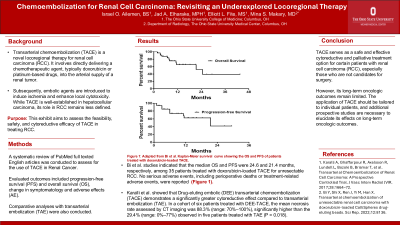
Results: Drug-eluting embolic (DEE) transarterial chemoembolization (TACE) demonstrates a significantly greater cytoreductive effect compared to transarterial embolization (TAE). In a cohort of six patients treated with DEE-TACE, the mean necrosis rate assessed by CT imaging was 88.3% (range: 70%–100%), significantly higher than the 29.4% (range: 0%–77%) observed in five patients treated with TAE (P = 0.018). A retrospective study indicated that the median OS and PFS were 24.6 and 21.4 months, respectively, among 35 patients treated with doxorubicin-loaded TACE for unresectable RCC. No serious adverse events, including perioperative deaths or treatment-related adverse events, were reported.
Conclusions: TACE serves as a safe and effective cytoreductive and palliative treatment option for certain patients with renal cell carcinoma (RCC), especially those who are not candidates for surgery. However, its long-term oncologic outcomes remain limited. The application of TACE should be tailored to individual patients, and additional prospective studies are necessary to elucidate its effects on long-term oncologic outcomes.