(72) Transvenous Biopsy of Pericaval Lymph Node After Nondiagnostic Sampling in Patient With Pancreatic Mass
Saturday, October 18, 2025
6:00 PM - 7:30 PM East Coast USA Time
Keely Adrian, N/A – Researcher, University of Wisconsin Madison; Chistopher Yeisley, MD – Interventional Radiologist, Naval Medical Center Portsmouth
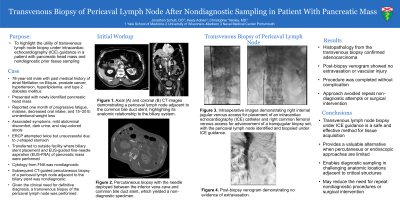
Purpose: To highlight the utility of transvenous lymph node biopsy under intracardiac echocardiography (ICE) guidance in a patient with pancreatic head mass and nondiagnostic prior tissue sampling.
Material and Methods: A 78-year-old male with a past medical history of atrial fibrillation on Eliquis, prostate cancer, hypertension, hyperlipidemia, and type 2 diabetes mellitus presented with a newly identified pancreatic head mass. He experienced approximately one month of progressive fatigue and malaise, decreased oral intake, and 15–20 pound unintentional weight loss. Associated symptoms included mild abdominal discomfort, dark urine, and clay-colored stools.
ERCP was attempted twice but was unsuccessful due to his J-shaped stomach. He was transferred to an outside facility, where successful biliary stent placement and endoscopic ultrasound-guided fine-needle aspiration (EUS-FNA) of the pancreatic mass were performed. However, cytology from the FNA was nondiagnostic. A subsequent CT-guided percutaneous biopsy targeting a pericaval lymph node adjacent to the biliary stent also failed to yield diagnostic material.
Given the clinical need for definitive diagnosis, a transvenous biopsy of the pericaval lymph node was performed. Internal jugular venous access was used for placement of the ICE catheter, and common femoral venous access was obtained for advancement of a transjugular biopsy set. Under ICE guidance, the target lymph node was visualized and sampled.
Results: Histopathology from the transvenous biopsy was diagnostic for adenocarcinoma. A post-biopsy venogram demonstrated no extravasation or vascular injury. The procedure was performed without complication and avoided repeat non-diagnostic attempts or surgical intervention.
Conclusions: Transvenous lymph node biopsy under ICE guidance provides a safe and effective method for obtaining diagnostic tissue. This technique offers a valuable alternative when conventional percutaneous or endoscopic approaches are limited by anatomy or proximity to critical structures.