(47) The Expanding Role of Balloon-Occluded TACE in Hepatocellular Carcinoma
Saturday, October 18, 2025
6:00 PM - 7:30 PM East Coast USA Time
Saad Badat, BA – Medical Student, Northeast Ohio Medical University; Mina Makary, MD – Clinical Assistant Professor, Division of Vascular and Interventional Radiology, The Ohio State University Wexner Medical Center
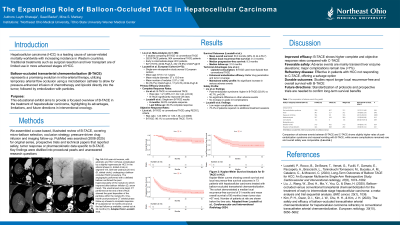
Purpose: This educational exhibit aims to provide a focused overview of balloon-occluded transarterial chemoembolization (B-TACE) in the treatment of hepatocellular carcinoma (HCC), highlighting its advantages, limitations, and future directions in interventional oncology.
Material and Methods: We assembled a case-based, illustrated review of B-TACE, covering micro-balloon selection, occlusion strategy, pressure-driven drug infusion and imaging follow-up. PubMed was searched (2008-2025) for original series, prospective trials and technical papers that reported safety, tumor response or pharmacokinetic data specific to B-TACE. Key findings were distilled into procedural pearls and unanswered research questions.
Results: B-TACE involves temporary arterial flow occlusion using a microballoon catheter, allowing for pressure-enhanced infusion of chemotherapy and lipiodol directly into the tumor, followed by embolization with particles. This technique promotes deeper drug penetration and reduces non-target spread. B-TACE has demonstrated robust effectiveness for treating HCC. In a large European cohort of 73 patients (mean tumor size ≈37 mm), B-TACE achieved a complete response rate of 58.9%, a median local recurrence–free survival of 31 months, and a mean overall survival of 50 months. A meta-analysis covering over 1,100 patients confirmed B‑TACE significantly improved both complete and objective response rates, without increasing serious adverse events. Despite its altered hemodynamic profile, B‑TACE maintains a low major complication rate (6.7%) with minimal and reversible liver enzyme elevations in treated patients. Overall, these findings highlight B‑TACE as both technically feasible and clinically effective, with a favorable safety profile and durable tumor control.
Conclusions: B-TACE is a promising evolution in intra-arterial therapy for HCC, offering a targeted and pressure-modulated approach to drug delivery. As experience with the technique grows, future work should focus on standardizing protocols, refining patient selection, and evaluating long-term outcomes. For trainees and practicing physicians alike, understanding B-TACE is increasingly relevant as it gains traction across global oncology centers.