Elliott Fite, MS – Medical Student, The Ohio State University College of Medicine; Israel Ailemen, BS – Medical Student, The Ohio State University College of Medicine; Mina Makary, MD – Associate Clinical Professor of Radiology, Department of Radiology, The Ohio State University Medical Center
Purpose: Catheter-directed immunotherapy (CDIT) is an evolving approach in interventional oncology that enables delivery of immunomodulatory agents directly into the tumor microenvironment. This abstract explores current advances in CDIT, emphasizing technological innovations, biologic rationale, and integration with multimodal oncologic strategies.
Material and Methods: A systematic review of PubMed-indexed studies was conducted, focusing on preclinical models and early-phase clinical trials evaluating catheter-directed delivery of immune checkpoint inhibitors, cytokines, and adoptive cellular therapies. Therapeutic platforms as well as procedural techniques involving arterial infusion were examined. Outcomes assessed included immune response modulation, safety, and feasibility.
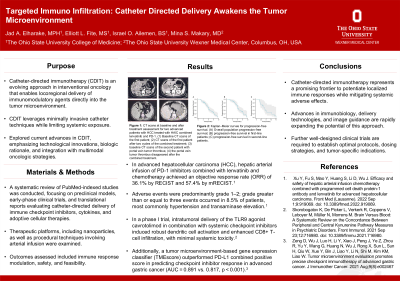
Results: CDIT has demonstrated encouraging results in both preclinical and early clinical studies.1-3 In advanced hepatocellular carcinoma (HCC), hepatic arterial infusion of PD-1 inhibitors combined with lenvatinib and chemotherapy achieved an objective response rate (ORR) of 36.1% by RECIST and 57.4% by mRECIST, with a disease control rate of 82.0% and median progression-free survival (PFS) of 6.0 months.4 In a separate first-line cohort, this combination significantly improved PFS compared to systemic therapy alone (11.1 vs. 5.1 months).4 Adverse events were predominantly grade 1–2; grade 3 events occurred in 8.5% of patients, most commonly hypertension and transaminase elevation.4 In a phase I trial, intratumoral delivery of the TLR9 agonist cavrotolimod in combination with systemic checkpoint inhibitors induced robust dendritic cell activation and enhanced CD8+ T-cell infiltration, with minimal systemic toxicity.5 Additionally, a tumor microenvironment-based gene expression classifier (TMEscore) outperformed PD-L1 combined positive score in predicting checkpoint inhibitor response in advanced gastric cancer (AUC = 0.891 vs. 0.817, p < 0.001), and was validated in an independent NanoString cohort (AUC = 0.877).6
Conclusions: Catheter-directed immunotherapy represents a promising frontier to potentiate localized immune responses while mitigating systemic adverse effects. Advances in immunobiology, delivery technologies, and image guidance are rapidly expanding the potential of this approach. Further well-designed clinical trials are required to establish optimal protocols, dosing strategies, and tumor-specific indications.