(69) Augmented Reality in Ablation of Liver Tumors: A Review of Current Evidence and Future Directions
Saturday, October 18, 2025
6:00 PM - 7:30 PM East Coast USA Time
Benjamin Templeton, BS – Medical Student, The Ohio State University College of Medicine; Shrina Jasani, BS – Medical Student, The Ohio State University College of Medicine; Elliott Fite, MS – Medical Student, The Ohio State University College of Medicine; Mina Makary, MD – Associate Clinical Professor of Radiology, Department of Radiology, The Ohio State University Medical Center
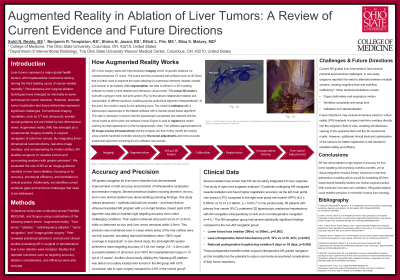
Purpose: Accurate localization and ablation of liver tumors remains a challenge in interventional oncology. Advances in augmented reality (AR) – integrating 3D visualization, motion compensation, and real-time image overlay – have shown promise in improving targeting and efficiency. This abstract explores the role of AR as a novel image-guidance modality for liver tumor ablation, focusing on feasibility, safety, and clinical efficacy.
Material and Methods: A literature review was conducted using PubMed, MEDLINE, and Scopus to identify peer-reviewed studies evaluating the use of AR in liver tumor ablation. Search terms included combinations of “augmented reality,” “liver tumor,” “radiofrequency ablation,” “thermal ablation,” and/or “tumor targeting.” Studies assessing intraoperative or percutaneous AR guidance were included. Factors such as accuracy, ablation completeness, and operator variability were assessed.
Results: AR-guided navigation has consistently demonstrated targeting errors of less than 5 mm across studies. In phantom models, smartphone-based AR outperformed CT, yielding significantly higher tumor ablation completeness (47% vs 36%, p = 0.004). Complementary preclinical studies using ultrasound assisted point cloud registration achieved entry point accuracy of 2.34 – 2.71 mm in phantoms and 4.5 – 5.0 mm in deformed ex vivo livers, validating AR’s role in compensating for tissue deformation. Collectively, these findings demonstrate AR’s ability to improve precision and efficiency in liver tumor ablation.
Conclusions: Utilization of AR in image-guided liver tumor ablation has strong preclinical evidence supporting its integration into both percutaneous and surgical workflows. As platforms continue to evolve, their clinical application will depend on overcoming challenges of intraoperative deformation remodeling and standardizing its validation.