(74) Systemic and Locoregional Synergy: Transarterial Chemoembolization Combined with TKIs and Immunotherapy
Saturday, October 18, 2025
6:00 PM - 7:30 PM East Coast USA Time
Jenish Venancius, MPH – Medical Student, The Ohio State University College of Medicine; Alex Rudich, BS – Medical Student, The Ohio State University College of Medicine; Elliott Fite, MS – Medical Student, The Ohio State University College of Medicine; Mina Makary, MD – Associate Clinical Professor of Radiology, Department of Radiology, The Ohio State University Medical Center
Purpose: For unresectable Hepatocellular Carcinoma (HCC) many double therapies have been used such as transarterial chemoembolization (TACE), tyrosine kinase inhibitors (TKIs), or TKIs combined with immunotherapy. This educational review will discuss studies using triple therapy with TACE, TKIs, and immunotherapy, and its outcomes on HCC survival.
Material and Methods: Several databases were searched (PubMed, Embase, Cochrane, MedLine, Web of Science) for clinical trials, systematic reviews, and case series. The search terms included combinations of "transarterial chemoembolization (TACE)", "tyrosine kinase inhibitor (TKI)" , and "immune checkpoint inhibitor (ICI)", along with "hepatocellular carcinoma (HCC)", with the outcomes of overall survival (OS), progression-free survival (PFS), objective response rate (ORR), disease control rate (DCR), and adverse events being assessed.
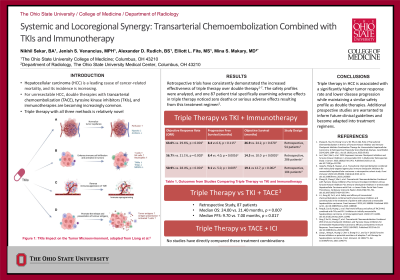
Results: Retrospective trials have consistently demonstrated the increased effectiveness of triple therapy over double therapy. TACE + TKI + ICI was compared with TKI + ICI in multiple trials, all which demonstrated a higher ORR (63.0% vs. 29.6%, p < 0.001, 56.7% vs. 21.1%, p = 0.002, 50.9% vs. 28.4%, p < 0.001), median PFS (8.4 months versus 6.6 months, p = 0.115, 8.4 vs. 4.0 months, p = 0.0016, and 9.1 vs. 5.0 months, p = 0.005), and OS (26.9 vs. 24.2 months, p = 0.670, 14.5 vs. 10.0 months, p < 0.0001, and 19.1 vs 12.7 months, p = 0.002) in triple vs double therapy. A trial measuring TACE + TKI + ICI vs TACE + TKI demonstrated a significantly longer median OS (24.00 vs. 21.40 months, p = 0.007) and median PFS (9.70 vs. 7.00 months, p = 0.017) in the triple therapy group as well. The safety profiles were analyzed, and one 87 patient trial specifically examining adverse effects in triple therapy noticed zero deaths or serious adverse effects resulting from this treatment regimen.
Conclusions: Triple therapy in HCC is associated with a significantly higher tumor response rate and lower disease progression while maintaining a similar safety profile as double therapies. Additional prospective studies are warranted to inform future clinical guidelines and become adapted into treatment regimens.