(42) Targeting Breast Cancer in the Liver: Comparative Insights on Transarterial Chemoembolization and Radioembolization
Saturday, October 18, 2025
6:00 PM - 7:30 PM East Coast USA Time
Lauren Stucky, BS – Medical Student, The Ohio State University College of Medicine; Elliott Fite, MS – Medical Student, The Ohio State University College of Medicine; Mina Makary, MD – Associate Clinical Professor of Radiology, Department of Radiology, The Ohio State University Medical Center
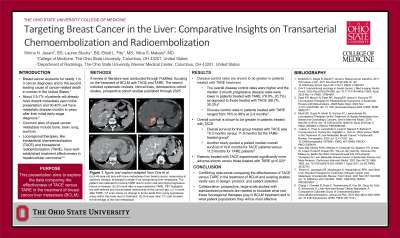
Purpose: Breast cancer accounts for nearly 1 in 3 cancer diagnoses and is the second leading cause of cancer-related death in women in the United States. About 3.5-7% of patients will already have distant metastasis upon initial presentation and 30-40% will have metastatic disease months to years after their initial early-stage diagnosis. Common sites of breast cancer metastasis include bone, brain, lung, and liver. Locoregional therapies, like transatrial chemoembolization (TACE) and transarterial radioembolization (TARE), have well-established effectiveness in hepatocellular carcinoma treatment. These therapies can have a role in the treatment of breast cancer liver metastasis (BCLM) in appropriately selected patients. The purpose of this abstract is to explore the data comparing the effectiveness of TACE versus TARE in the treatment of BCLM.
Material and Methods: A review of literature was conducted through PubMed. The search included systematic reviews, clinical trials, retrospective cohort studies, and prospective cohort studies published through 2025.
Results: In patients with BCLM, the overall disease control rates were higher and the median 3-month progressive disease rates were lower in patients treated with TARE (78.9%, 20.7%) as opposed to those treated with TACE (68.7%, 30.3%). An additional study demonstrated disease control rates ranging from 78% to 96% at 2-4 months. Furthermore, a study noted that the pooled response rates for TARE were higher at 49% in contrast to 34% for TACE. However, the overall survival was longer for the TACE group at 15.3 months versus 11.9 months for the TARE group. Another systematic review quoted a pooled median overall survival of 19.6 months for TACE patients in comparison to 11.5 months for TARE patients. A retrospective cohort study found that significantly more adverse events were experienced by patients treated by TACE versus those treated by TARE (p = 0.02).
Conclusions: Conflicting data exists comparing the effectiveness of TACE versus TARE in the treatment of BCLM. Moreover, the studies that do exist are widely heterogenous and greatly vary in design, protocol, and patient selection. Collaborative, prospective, large-scale studies with standardized protocols are needed to elucidate what role these locoregional therapies play in BCLM treatment and in what patient populations they will be most effective.