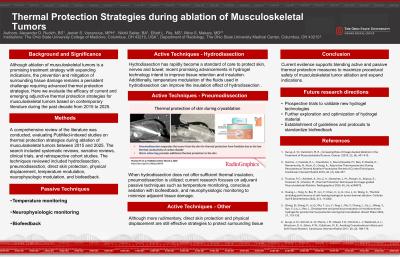
(70) Thermal Protection Strategies during ablation of Musculoskeletal Tumors
Saturday, October 18, 2025
6:00 PM - 7:30 PM East Coast USA Time
Jenish Venancius, MPH – Medical Student, The Ohio State University College of Medicine; Elliott Fite, MS – Medical Student, The Ohio State University College of Medicine; Nikhil Sekar, BA – Medical Student, The Ohio State University College of Medicine; Mina Makary, MD – Associate Clinical Professor of Radiology, Department of Radiology, The Ohio State University Medical Center
Purpose: Although ablation of musculoskeletal tumors is a promising treatment strategy with expanding indications [1], the prevention and mitigation of surrounding tissue damage remains a persistent challenge requiring advanced thermal protection strategies [2]. This analysis aims to review and evaluate the efficacy of current and emerging adjunctive thermal protection strategies for musculoskeletal tumors based on contemporary literature during the past decade from 2015 to 2025.
Material and Methods: A comprehensive review of the literature was conducted, evaluating PubMed-indexed studies on thermal protection strategies during ablation of musculoskeletal tumors between 2015 and 2025. The search included systematic reviews, narrative reviews, clinical trials, and retrospective cohort studies. The techniques reviewed included hydrodissection, pneumodissection, direct skin protection, physical displacement, temperature modulation, neurophysologic modulation, and biofeedback.
Results: This educational exhibit will outline recent updates and advancements in both active and passive thermal protection strategies in musculoskeletal tumor ablation. The exhibit will outline each active technique and its indications before highlighting contemporary advancements. Namely, hydrodissection has rapidly become a standard of care to protect skin, nerves and bowel [3]; recent promising advancements in hydrogel technology intend to improve tissue retention and insulation [4, 5]. Additionally, temperature modulation of the fluids used in hydrodissection can improve the insulation effect of hydrodissection [3]. When hydrodissection does not offer sufficient thermal insulation, pneumodissection is utilized; current research focuses on adjuvant passive techniques such as temperature monitoring, conscious sedation with biofeedback, and neurophysiologic monitoring to minimize adjacent tissue damage [3]. Although more rudimentary, direct skin protection and physical displacement are still effective strategies to protect surrounding tissue [6]. Lastly, the exhibit will review the current data on passive techniques and their role in augmenting the safety of ablation in musculoskeletal tumors.
Conclusions: Current evidence supports blending active and passive thermal protection measures to maximize procedural safety of musculoskeletal tumor ablation and expand indications.