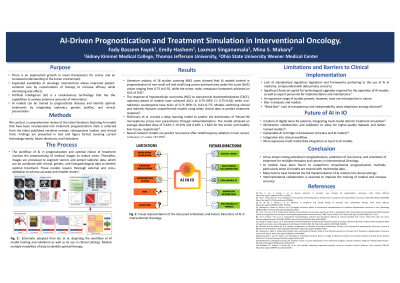
(21) AI-driven Prognostication and Treatment Simulation in Interventional Oncology
Saturday, October 18, 2025
6:00 PM - 7:30 PM East Coast USA Time
Emily Hashem, BS – Medical Student, Sidney Kimmel Medical College, Thomas Jefferson University, 111 S 11th St, Philadelphia, PA 19107, United States.; Laxman Singanamala, BS – Medical Student, Sidney Kimmel Medical College, Thomas Jefferson University, 111 S 11th St, Philadelphia, PA 19107, United States.; Mina Makary, MD – Physician, Division of Vascular and Interventional Radiology, Department of Radiology, The Ohio State University Wexner Medical Center, 410 West Tenth Avenue, Columbus, OH 43210, United States
Purpose: Interventional Oncology (IO) is rapidly evolving, with novel therapeutics constantly being developed and a greater understanding of the tumor environment being attained. The goal of cancer therapy is to improve treatment efficacy through increased survival and patients’ quality of life, while limiting side effects. This allows for refined decision-making on optimal therapy choice rooted in patient-centered care. This educational exhibit covers the latest advances of Artificial Intelligence (AI) in the prognostication of disease progression and the simulation of treatment before treatment.
Material and Methods: We conduct a comprehensive review of the latest literature featuring AI models that have been incorporated into treatment prognostication. Data is collected from the latest published narrative reviews, retrospective studies, and clinical trials. Findings are presented in text and figure format covering current technology trends, future directions, and limitations.
Results: Multiple AI models have been trained to extract radiomics. Through training on previous datasets, models can compare quantitative features from a medical image at hand and predict the response to treatment. AI models have the added power of integrating features from different imaging modalities. The incorporation of clinicopathological data has shown heightened potential in AI prognostication. In non-small cell lung carcinoma, AI models surpassed the traditional tumor, node, metastasis (TNM) staging systems in predicting disease-free survival. Another study showed convoluted neural networks can potentially improve traditional staging systems in predicting the success of Transarterial Chemoembolization (TACE) in Hepatocellular Carcinoma (HCC). With many trials showing impressive evaluation metrics, it must be considered that many of the studies are retrospective with limited datasets. Additionally, many AI models have opaque decision-making, reducing physician trust in them.
Conclusions: With recent global trends, AI has shown itself to be a revolutionary technology whose effects have swept through multiple industries. Concerning IO, it can analyze vast amounts of imaging and clinical data. The hurdles to the full implementation of AI in clinical settings cannot be ignored; further comprehensive and large-scale research is required to fully understand its integration into clinical workflows and gain the full trust of the interventional community.