(23) Technological Breakthroughs in Irreversible Electroporation: The Future of Non-Thermal Ablation
Saturday, October 18, 2025
6:00 PM - 7:30 PM East Coast USA Time
Emily Hashem, BS – Medical Student, Sidney Kimmel Medical College, Thomas Jefferson University, 111 S 11th St, Philadelphia, PA 19107, United States.; Laxman Singanamala, BS – Medical Student, Sidney Kimmel Medical College, Thomas Jefferson University, 111 S 11th St, Philadelphia, PA 19107, United States.; Mina Makary, MD – Physician, Division of Vascular and Interventional Radiology, Department of Radiology, The Ohio State University Wexner Medical Center, 410 West Tenth Avenue, Columbus, OH 43210, United States.
Purpose: Irreversible Electroporation (IRE) is an evolving interventional oncology technique that provides non-thermal ablation and kills tumor cells via pyroptosis, necroptosis, or programmed necrosis. It provides a promising alternative in neoplasm elimination, particularly near heat-intolerant structures. This educational exhibit examines the latest strides that IRE has made in tumor ablative therapy, as well as in combination with other locoregional therapies.
Material and Methods: A literature review of the latest clinical trials, systematic reviews, and treatment guidelines is conducted, detailing novel technological advancements of this therapy as well as its efficacy in treating locally advanced pancreatic cancer, liver cancer, prostate cancer, and renal cell carcinoma. Emerging trends and limitations associated with this rapidly evolving therapeutic modality are also covered.
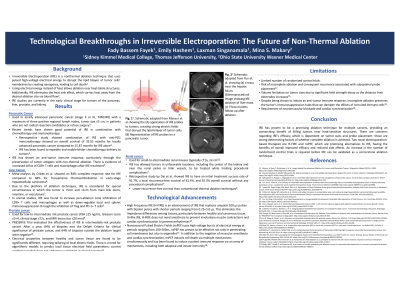
Results: IRE has shown great potential as a promising treatment modality in treating primary and metastatic tumors across multiple organs. Two emerging modalities of IRE are High-Frequency IRE (H-FIRE) and Nanosecond Pulsed Electric Fields (nsPEF); H-FIRE incorporates short bursts of bipolar pulses, negating the need for cardiac synchronization and intravenous muscular paralytics. On the other hand, nsPEF has the additional benefit of targeting intracellular organelles. IRE has been found to have a synergistic effect when combined with other cancer therapies. Studies have shown improved survival when IRE was combined with chemotherapy and anti-PD-1/ PD-L1 checkpoint blockade therapy. IRE still presents significant challenges to be tackled before its capabilities can be fully leveraged in clinical settings- this includes limited ablation volume due to the exponential field strength decay as distance from electrodes increases. Another facet that must be explored is the hindered anti-tumor immune efficacy induced by this therapy. Further research is also required to optimize pulse parameters to maximize effectiveness while minimizing side effects.
Conclusions: IRE is a highly promising therapeutic modality that can be leveraged for many types of cancers across the body. While providing some advantages over traditional thermal ablation techniques, IRE has its downsides. Further research into IRE’s efficacy and safety is required before it can be transitioned from an investigational to an established treatment.