(77) Ablation of Bone Tumors as a Method of Pain Reduction in Metastatic Cancer
Saturday, October 18, 2025
6:00 PM - 7:30 PM East Coast USA Time
Fady Bassem Fayek, B.S. – Medical Student, Sidney Kimmel Medical College; Emily Hashem, B.S. – Medical Student, Sidney Kimmel Medical College; Mina Makary, M.D. – Physician, Division of Vascular and Interventional Radiology, Department of Radiology, The Ohio State University Wexner Medical Center
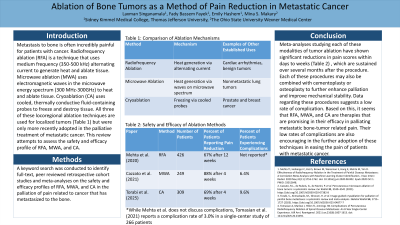
Purpose: Metastasis to bone is often incredibly painful for patients with cancer. Locoregional tumor ablation using techniques such as radiofrequency ablation, microwave ablation, and cryoablation has potential to decrease the amount of pain these patients experience. This educational exhibit discusses the efficacy of these methods of tumor ablation.
Material and Methods: A literature review was conducted to determine the safety and efficacy profiles of three techniques of tumor ablation (radiofrequency ablation, microwave ablation, and cryoablation) in the palliation of pain related to cancer that has metastasized to bone.
Results: Radiofrequency ablation (RFA) is a technique that uses medium frequency (350-500 kHz) alternating current to generate heat and ablate tissue. RFA is the standard treatment for the ablation of several cardiac arrhythmias as well as benign tumors. Microwave ablation (MWA) uses electromagnetic waves in the microwave energy spectrum (300 MHz-300GHz) to heat and ablate tissue. MWA is an established treatment for nonmetastatic lung tumors. Cryoablation (CA) uses cooled, thermally conductive fluid-containing probes to freeze and destroy tissue. It is used as a treatment for prostate and breast cancer. These techniques are all established in their treatment of localized tumors, but only have more recently been adopted in the palliative treatment of metastatic cancer. Meta-analyses studying each of these modalities of tumor ablation have shown significant reductions in pain scores within days to weeks, which are sustained over several months after the procedure. Each of these procedures may also be combined with cementoplasty or osteoplasty to further enhance palliation and improve mechanical stability. Data regarding these procedures suggests a low rate of complication.
Conclusions: RFA, MWA, and CA are therapies that are promising in their efficacy in palliating metastatic bone-tumor related pain. Their low rates of complications are also encouraging in the further adoption of these techniques in easing the pain of patients with metastatic cancer.