(61) Thermal Ablation in Non-Small Cell Lung Cancer: Evaluation of Recurrence Rates
Mina Makary, MD – Vascular and Interventional Radiologist, Department of Vascular and Interventional Radiology, Ohio State University Wexner Medical Center; Satya Morar, MHM – Medical Student, Case Western Reserve University School of Medicine; Sunny Shastri, BS – Medical Student, Nova Southeastern University College Of Osteopathic Medicine
Purpose: Lung cancer is one of the most common causes of cancer-related mortality for both men and women in the US; as such, the utilization of alternative treatment modalities, such as ablation procedures, are essential to improving outcomes. This review will examine post-operative recurrence rates of NSCLC in patients who received tumor ablation procedures.
Material and Methods: A review of randomized control and clinical trials published between 2015 and 2025 investigating NSCLC recurrence rates in patients who underwent ablation therapy was conducted. The studies evaluated described the ablation procedure and protocols, as well as their observed local recurrence rates as a percentage of the total patients followed. Side effects as noted by the study authors were also reviewed.
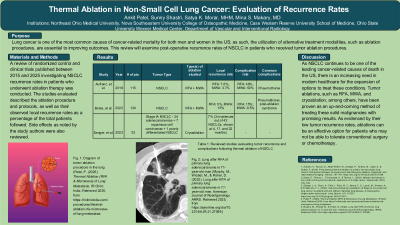
Results: Several studies have been conducted to evaluate the efficacy of different tumor ablation procedures based on post-operative tumor recurrence rates. A 2019 study from Aufranc et. al studied radiofrequency ablations (RFAs) and microwave ablations (MWAs) in 115 patients, finding a 7.6% and 3.7% recurrence rate in the RFA and MWA groups, respectively. This demonstrated the efficacy of both techniques in preventing tumor recurrence, though MWA was found to be the superior method. They also reported pneumothoraces as the most common complication seen in their patients. Specifically, there was a 40.5% rate of pneumothorax occurrence in the RFA group and a 24.7% rate in the MFA group. Conversely, a 2022 study by Botsa et al. similarly investigated both RFAs and MWAs in 124 patients, and found that the MWA group had a larger recurrence rate at 15%, compared to the RFA group at 5%. They also saw pneumothoraces in 3 RFA and 4 MFA patients, as well as post-ablation syndrome in 15% and 8.3% of RFA and MFA patients, respectively. Meanwhile, a 2023 study by Sanger et. al evaluated the success of cryoablations in 33 patients, noting a 7% recurrence rate (3 patients, presenting at 4, 17, and 22 months). They reported 3 Adverse Events grade 3 or above during their follow-up period, as well as 12 pneumothoraces.
Conclusions: Tumor ablations, such as RFA, MWA, and cryoablation, have been proven as an effective method of treating solid tumors with low tumor recurrence rates. Ablations may be an effective option for patients who can not tolerate conventional surgery or chemotherapy, but more research is needed to reach a consensus on localized recurrence rate trends.