(57) Expanding Indications for Locoregional Treatments in Interventional Oncology
Saturday, October 18, 2025
6:00 PM - 7:30 PM East Coast USA Time
Marcus Hong, N/A – Medical Student, The Ohio State University College of Medicine; Mina Makary, MD – Physician, Radiology, The Ohio State University Wexner Medical Center
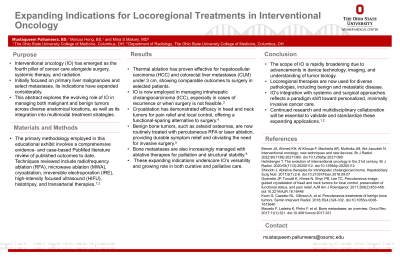
Purpose: Interventional oncology (IO) has emerged as the fourth pillar of cancer care alongside surgery, systemic therapy, and radiation. Initially focused on primary liver malignancies and select metastases, its indications have expanded considerably. This abstract explores the evolving role of IO in managing both malignant and benign tumors across diverse anatomical locations, as well as its integration into multimodal treatment strategies.
Material and Methods: A comprehensive review of the literature was conducted to examine the application of image-guided ablative, embolic, and immunomodulatory therapies across tumor types. Focus was placed on novel technologies, expanding anatomical indications, and emerging clinical scenarios such as non-surgical candidates or recurrent disease. Techniques reviewed include radiofrequency ablation (RFA), microwave ablation (MWA), cryoablation, irreversible electroporation (IRE), high-intensity focused ultrasound (HIFU), histotripsy, and transarterial therapies.
Results: Thermal ablation has proven effective for hepatocellular carcinoma (HCC) and colorectal liver metastases (CLM) under 3 cm, showing comparable outcomes to surgery in selected patients. IO is now employed in managing intrahepatic cholangiocarcinoma (ICC), especially in cases of recurrence or when surgery is not feasible. Cryoablation has demonstrated efficacy in head and neck tumors for pain relief and local control, offering a functional-sparing alternative to surgery. Benign bone tumors, such as osteoid osteomas, are now routinely treated with percutaneous RFA or laser ablation, providing durable symptom relief and obviating the need for invasive surgery. Bone metastases are also increasingly managed with ablative therapies for palliation and structural stability. These expanding indications underscore IO’s versatility and growing role in both curative and palliative care.
Conclusions: The scope of IO is rapidly broadening due to advancements in device technology, imaging, and understanding of tumor biology. Locoregional therapies are now used for diverse pathologies, including benign and metastatic disease. IO’s integration with systemic and surgical approaches reflects a paradigm shift toward personalized, minimally invasive cancer care. Continued research and multidisciplinary collaboration will be essential to validate and standardize these expanding applications.