(91) Y-90 Segmentectomy in Hepatocellular Carcinoma: Evaluating Safety, Tolerability, and Risk Mitigation
Saturday, October 18, 2025
6:00 PM - 7:30 PM East Coast USA Time
Delmarie Rivera Rodriguez, BS – Research Fellow, Interventional Radiology, Northwestern Feinberg School of Medicine; Samdeep Mouli, MS, MD – Faculty, Interventional Radiology, Northwestern Feinberg School of Medicine
Purpose: To assess the adverse events (AEs) and curative potential of Yttrium-90 (Y-90) segmentectomy in patients with early-stage hepatocellular carcinoma (HCC), with a focus on transient and severe side effects.
Material and Methods: A targeted literature review was conducted to evaluate the safety profile and AEs associated with Y-90 segmentectomy in patients with HCC. Sources included peer-reviewed retrospective, prospective, and institutional studies focused on outcomes such as tumor control, treatment-related toxicity, and management of AEs.
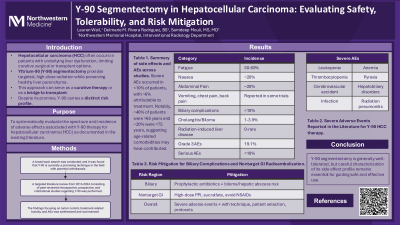
Results: HCC often presents in patients with underlying liver dysfunction, limiting surgical or transplant options. Y-90 radioembolization is an effective liver-directed therapy with curative potential for early-stage HCC confined to one or two segments, providing a bridge to transplant or an alternative to surgery. Y-90 beads have a short radioactive radius and are delivered through arteries mapped via angiography. Multiple trials support that Y-90 segmentectomy reduces tumor size and progression, with response rates up to 88%. Of the transient AEs seen in trials involving Y-90 segmentectomy, ~50% of patients experience fatigue and 20% experience nausea. More serious AEs were less commonly found with < 10% of patients experiencing biliary complications, but only < 2% of those complications required intervention. One trial reported severe AEs such as cerebrovascular accident and thrombocytopenia in one patient each and reported no radiation induced liver diseases. The risk of nontarget pulmonary exposure is < 1% and risk of nontarget GI radioembolization is ~3% across studies but is decreasing as technology improves. These studies show Y-90 segmentectomy mostly causes AEs like fatigue, nausea, and abdominal pain, with few patients needing care for biliary issues or liver injury and with minimal risk of nontarget complications.
Conclusions: Y-90 segmentectomy offers a targeted, well-tolerated treatment for HCC, with strong local control and outcomes comparable to curative therapies in select patients. It offers a favorable safety profile, with most adverse effects limited to mild fatigue, nausea, and vomiting. Future directions should focus on enhancing real-time dosimetry, improving imaging techniques to detect off-target delivery, and developing predictive models for AEs.