(48) Irreversible Electroporation: A Non-Thermal Modality for Central Pancreatic Tumors
Saturday, October 18, 2025
6:00 PM - 7:30 PM East Coast USA Time
Saad Badat, BA – Medical Student, Northeast Ohio Medical University; Mina Makary, MD – Clinical Assistant Professor, Division of Vascular and Interventional Radiology, The Ohio State University Wexner Medical Center
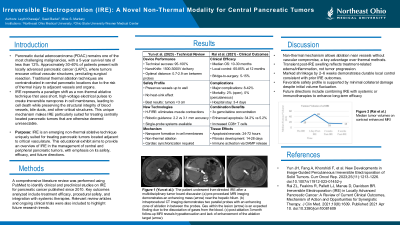
Purpose: Irreversible electroporation (IRE) is an emerging non-thermal ablative technique uniquely suited for treating pancreatic tumors located adjacent to critical vasculature. This educational exhibit aims to provide an overview of IRE in the management of central and peripheral pancreatic tumors, with emphasis on its safety, efficacy, and future directions.
Material and Methods: A comprehensive literature review was performed using PubMed to identify clinical and preclinical studies on IRE for pancreatic cancer published since 2010. Key outcomes analyzed include treatment efficacy, procedural safety, and integration with systemic therapies. Relevant review articles and ongoing clinical trials were also included to highlight future research trends.
Results: IRE has demonstrated the ability to improve local tumor control and overall survival in patients with locally advanced pancreatic cancer not amenable to surgery or thermal ablation. Studies show favorable safety profiles and compatibility with vascular structures. Preclinical and early clinical evidence supports IRE’s potential to enhance immunogenicity and synergize with immunotherapies. Recent and ongoing trials are evaluating IRE in combination regimens and as a bridge to resection. Technological refinements and image-guided approaches continue to expand its therapeutic applications.
Conclusions: IRE represents a promising non-thermal modality for locoregional management of pancreatic tumors, especially those centrally located. Its evolving role in multimodal therapy, potential immunologic synergy, and expanding evidence base signal a shift toward broader clinical adoption in pancreatic cancer treatment paradigms.