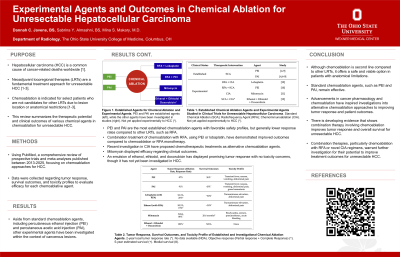
(44) Experimental Agents and Outcomes in Chemical Ablation for Unresectable Hepatocellular Carcinoma
Saturday, October 18, 2025
6:00 PM - 7:30 PM East Coast USA Time
Sabrina Almashni, B.S. – Medical Student, The Ohio State University College of Medicine; Mina Makary, M.D. – Faculty, Division of Vascular & Interventional Radiology, Wexner Medical Center
Purpose: This review summarizes the therapeutic potential and clinical outcomes of chemical agents used in chemical ablation (CA) of unresectable hepatocellular carcinoma (HCC) based on current guidelines and recent studies.
Material and Methods: A literature search focused on prospective trials and meta-analyses published between 2013-2025 was conducted using the PubMed database. Relevant literature was identified and included with special attention given to CA modalities including percutaneous ethanol injection (PEI), percutaneous acetic acid injection (PAI), and investigational approaches such as combination with radiofrequency ablation (RFA) and chemo-immunoablation (CIA). Data were assessed for tumor response, survival outcomes, and toxicity profiles to evaluate the comparative efficacy of each agent.
Results: Neoadjuvant locoregional therapies (LRTs) have become a standard treatment approach for unresectable HCC by providing localized control of disease. CA is typically reserved for select patients who are not candidates for other LRTs due to lesion location or anatomy. Among CA agents, PEI and PAI are the most established, with favorable safety profiles but generally lower response rates compared to RFA, especially for small tumors. However, investigation of CA combined with RFA, using PEI and lobaplatin as the chemical agents, has demonstrated improved outcomes in select cases compared to CA or RFA monotherapy, without any serious adverse effect. Recent studies exploring CIA have proposed other promising agents, though more investigation is needed. While experimental combinations involving the agents ethanol, ethiodol, and doxorubicin have shown promise in small-scale studies, their application to HCC is still investigational and not yet part of standard care.
Conclusions: Although CA is second line compared to other LRTs, it offers a safe and viable option in patients with anatomical limitations. Standard agents, such as PEI and PAI remain effective, but combination therapies, particularly CA with RFA or novel investigational CIA regimens, warrant further investigation for their potential to improve outcomes.