(5) Comparative Outcomes of DEBIRI-TACE and TARE in Unresectable Colorectal Metastases: A Review of Recent Evidence
Saturday, October 18, 2025
6:00 PM - 7:30 PM East Coast USA Time
Emily Pfahl, BS – Medical Student, The Ohio State University College of Medicine; Dannah Javens, BS – Medical Student, The Ohio State University College of Medicine; John Heyniger, BS – Medical Student, The Ohio State University College of Medicine; Mina Makary, MD – Division of Vascular & Interventional Radiology, The Ohio State University Wexner Medical Center
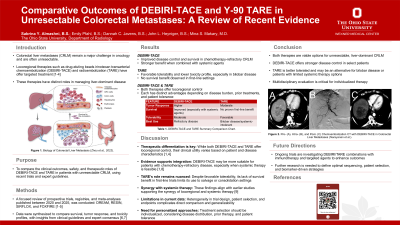
Purpose: This review evaluates the clinical outcomes, safety profiles, and therapeutic roles of drug-eluting beads irinotecan transarterial chemoembolization (DEBIRI-TACE) and radioembolization (TARE) in patients with unresectable colorectal liver metastases (CRLM), based on recent clinical evidence and guideline recommendations.
Material and Methods: A focused review of prospective trials, registries, and meta-analyses published between 2020 and 2025, was conducted, including DREAM, RESIN, SIRFLOX, and FOXFIRE. Data were synthesized to compare survival, tumor response, and toxicity profiles, with insights from clinical guidelines and expert consensus.
Results: Transarterial therapies have become integral to the management of unresectable, liver-dominant CRLM, offering locoregional control with distinct therapeutic profiles. DEBIRI-TACE demonstrated promising disease control in chemotherapy-refractory CRLM, with enhanced outcomes when combined with systemic agents. These findings align with earlier studies supporting the synergy of locoregional and systemic therapy. TARE, while associated with lower response rates, demonstrated favorable tolerability, particularly in patients with bilobar disease or limited systemic therapy intolerance. However, randomized trials have not shown a survival benefit for TARE in first-line settings, reinforcing its role as a salvage or consolidation strategy.
Conclusions: Both therapies are viable options for liver-dominant, unresectable CRLM. DEBIRI appears to offer improved disease control and survival in select patients, while TARE remains a well-tolerated alternative in patients with bilobar disease or chemotherapy intolerance. Treatment should be individualized based on tumor burden, liver function, and multidisciplinary input. Ongoing trials are exploring combinations with immunotherapy and targeted agents.