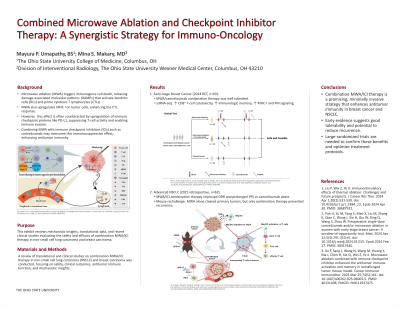
(85) Combined Microwave Ablation and Checkpoint Inhibitor Therapy: A Synergistic Strategy for Immuno-Oncology
Saturday, October 18, 2025
6:00 PM - 7:30 PM East Coast USA Time
Mina Makary, MD – Associate Professor, Division of Interventional Radiology, The Ohio State University Wexner Medical Center
Purpose: Microwave ablation (MWA) induces immunogenic cell death of cancer cells, initiating a tumor-specific immune response. While harnessing this effect has shown promise in cancer treatment, its efficacy is limited by immunosuppressive mechanisms within the tumor and its microenvironment. Of particular interest, MWA has been associated with upregulation of immune checkpoint proteins like PD-L1 on tumor cells, leading to peripheral suppression of cell-mediated immunity. This association supports the potential of combining MWA with immune checkpoint inhibitors (ICIs) like camrelizumab to amplify antitumor immunity. This educational exhibit reviews mechanistic insights and clinical evidence on the safety and efficacy of combination MWA and ICI therapy in non-small cell lung carcinoma (NSCLC) and breast carcinoma.
Material and Methods: A review of translational and clinical studies on MWA/ICI combination therapy was conducted, focusing on safety, clinical outcomes, antitumor immune response, and mechanistic insights.
Results: Recent studies in early-stage breast cancer and advanced NSCLC support the safety of MWA/ICI combination therapy and suggest a synergistic antitumor immune response. In early-stage breast cancer, a randomized 2024 study of 60 patients showed that MWA/camrelizumab combination therapy was well tolerated. scRNA-seq of peripheral blood indicated augmented cell-mediated immunity, increased cytotoxicity and immunologic memory in peripheral CD8+ T cells, and activation of MHC class I and interferon signaling pathways. In a 2025 retrospective study of 62 advanced NSCLC patients, MWA/ICI combination therapy demonstrated a higher objective response rate and significantly prolonged progression-free survival than camrelizumab alone. In the subsequent mouse rechallenge model, while MWA alone eliminated primary tumors, only the combination with ICIs suppressed rechallenged tumor growth and recurrence, suggesting a sustained immune-mediated effect.
Conclusions: Combining MWA with ICI therapy is a promising approach in enhancing the antitumor immune response in breast cancer and NSCLC. These early findings position this cancer treatment as a minimally invasive, well-tolerated treatment approach with potential to prevent recurrence. Large randomized trials are necessary to provide more support for these findings and optimize treatment protocols.