(2) Artificial Intelligence in TACE: Predictive Modeling for Patient Outcomes and Treatment Response
Saturday, October 18, 2025
6:00 PM - 7:30 PM East Coast USA Time
Jad Elharake, MPH – Medical Student, The Ohio State University College of Medicine; Elliott Fite, MS – Medical Student, The Ohio State University College of Medicine; Mina Makary, MD – Associate Clinical Professor of Radiology, Department of Radiology, The Ohio State University Medical Center
Purpose: Accurately determining the optimal patient-specific treatment strategy remains a significant challenge in the delivery of Transarterial Chemoembolization (TACE) in the treatment for Hepatocellular Carcinoma (HCC). Recent advances have shown that artificial Intelligence (AI) algorithms developed from clinical, imaging, and laboratory data can predict treatment response and short-term survival. This abstract explores AI’s use as both a prognostic tool and predictor of therapeutic efficacy.
Material and Methods: A review was performed using PubMed, MEDLINE, and Embase. Keywords included combination of “HCC”, “AI” “TACE” “machine learning” (ML), and/or “deep learning” (DL). Consideration was given to ML in exploring recurrence of HCC in liver transplants [1]. AI models like DSA Net[2], EfficientNetv2 [3], and others were use to highlight the use of AI in TACE.
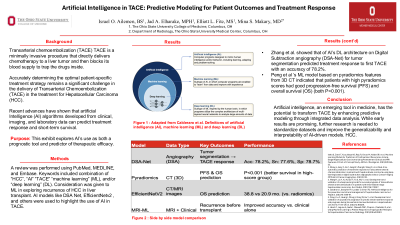
Results: ML improves model performance through repeated iterations, while DL, a subset of ML, uses neural networks inspired by the human brain. Recent DL applications have shown promise in predicting HCC risk, detecting HCC, and forecasting treatment responses across various data sources [4]. The use of AI’s DL architecture on Digital Subtraction angiography (DSA-Net) for tumor segmentation predicted treatment response to first TACE with an accuracy of 78.2%, sensitivity of 77.6%, and specificity of 78.7% [2].
An ML model based on pyradiomics features from 3D CT indicated that patients with high pyradiomics scores had good progression-free survival (PFS) and overall survival (OS) (both P< 0.001) [5]. EfficientNetV2, a DL model that functions as an effective image analyzer, demonstrated better OS (38.8 months vs. 20.9 months) for TACE compared to radiomics in treatment-naïve, intermediate-stage HCC patients [3]. ML-based models can predict HCC recurrence before therapy allocation in early-stage HCC patients eligible for liver transplant. Incorporating MRI data as a model input enhanced the predictive performance compared to clinical parameters alone [1].
Conclusions: Artificial intelligence has the potential to transform TACE by enhancing predictive modeling through integrated data analysis. While early results are promising, further research is needed to standardize datasets and improve the generalizability of AI-driven models in order to optimize care for HCC patients.