(92) Radiation Pneumonitis in Y90 Radioembolization
Saturday, October 18, 2025
6:00 PM - 7:30 PM East Coast USA Time
Elliott L. Fite, MS – Medical Student, The Ohio State University College of Medicine; Mina Makary, MD – Physician, Ohio State University
Purpose: Radiation pneumonitis (RP) is a rare but serious complication of Yttrium-90 (Y-90) radioembolization. The current guideline recommends a maximum lifetime lung dose of 30 Gy per treatment and 50 Gy in a lifetime. The purpose of this educational exhibit is to review the need for updated guideline with an aim to personalize a patient’s lung dose limit based on their treatment plans as well as their lung health and characteristics.
Material and Methods: We present an evaluation of a systemic review that identified 48 RP cases after Y-90, classifying based on microsphere type, hepatopulmonary shunt fraction, and estimated lung dose. We also reviewed studies addressing limitations in lung dose estimation, including how to more accurately estimate patient-specific dosimetry, predicting microsphere distribution, and correcting vendor-related biases in calculating lung mean dose.
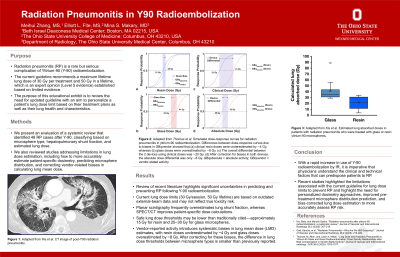
Results: Review of recent literature highlights significant uncertainties in predicting and preventing RP following Y-90 radioembolization. Current lung dose limits (30 Gy/session, 50 Gy lifetime) are based on outdated external-beam data and may not reflect true toxicity risk. Planar scintigraphy frequently overestimates lung shunt fraction, whereas SPECT/CT improves patient-specific dose calculations. Safe lung dose thresholds may be lower than traditionally cited—approximately 15 Gy for resin and 25–30 Gy for glass microspheres. Furthermore, vendor-reported activity introduces systematic biases in lung mean dose (LMD) estimates, with resin doses underestimated by ~4 Gy and glass doses overestimated by ~8 Gy. After correcting for these biases, the difference in lung dose thresholds between microsphere types is smaller than previously reported.
Conclusions: With a rapid increase in use of Y-90 radioembolization by IR, it is imperative that physicians understand the clinical and technical factors that can predispose patients to PR. Recent studies highlighted the limitations associated with the current guideline for lung dose limits to prevent RP and highlight the need for personalized dosimetry approaches, improved pre-treatment microsphere distribution prediction, and bias-corrected lung dose estimation to more accurately assess RP risk.