(60) State-of-the-art Musculoskeletal Interventions for Metastatic Osseous Disease: Current Updates and Future Directions
Sunny Shastri, BS – Medical Student, Nova Southeastern University College Of Osteopathic Medicine; Satya Morar, MHM – Medical Student, Case Western Reserve University School of Medicine; Mina Makary, MD – Vascular and Interventional Radiologist, Department of Vascular and Interventional Radiology, Ohio State University Wexner Medical Center
Purpose: The expanding role of MSK interventions for osseous metastases have incorporated many different techniques, including radiofrequency ablations (RFA), cryoablations, percutaneous osteosynthesis with cementoplasty augmentation (POC), and electrochemical therapy (ECT). This exhibit will examine current updates and future directions of these interventions.
Material and Methods: A review of randomized control and clinical trials published between 2015 and 2025 on RFA, MWA, POC, and ECT for treating metastatic bone cancer was conducted. The chosen studies were evaluated on efficacy of these procedures via decreases in mean VAS score and tumor response rates in their study populations.
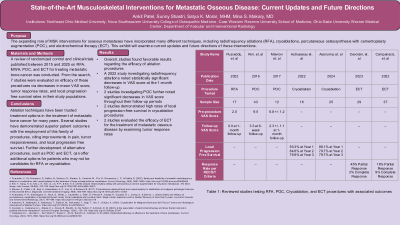
Results: Ablation techniques have been employed for the targeted treatment of solid tumors for many years. A 2022 study by Pusceddu et. al noted statistically significant decreases in mean VAS score at 1 week, 1 month, and 3 month follow-ups for RFA patients. Cryoablations have also been shown to demonstrate therapeutic benefit, as studies by Autruss et al. in 2022 and Asanuma et al. in 2024 have both reported statistically significant decreases in total local progression-free survival rates at 3 years post-cryoablation. Another popular treatment modality for secondary bone cancer includes POC; studies from Kim et. al and Mavrovi et. al demonstrated a 6.2 and 4.5 point reduction in mean VAS score across 43 and 12 patients, respectively. Another increasingly popular treatment option is ECT. A 2023 study from Cevolani et. al investigated tumor response to ECT in 29 patients; they reported that 45% of patients showed partial response to the therapy as per the RECIST criteria, with 3% achieving complete response. These results differ slightly from a 2022 study by Campanacci et. al, who instead found a 16% partial response rate and a 9% complete response rate in 37 ECT patients. While both have shown initial promise, further research is needed to further establish these techniques.
Conclusions: Ablation techniques have been trusted treatment options in the treatment of metastatic bone cancer for many years. Development of alternative procedures, such as percutaneous osteosynthesis with cementoplasty augmentation and electrochemical therapy, can offer additional options for patients who may not be candidates for ablation.